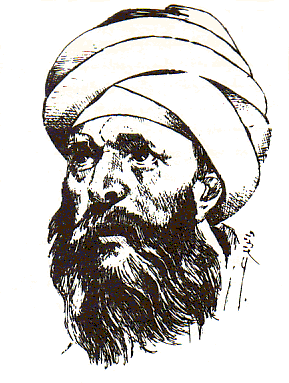
Best Dressed?

posted by Horace Jeffery Hodges @ 3:53 AM
0 comments


Brainstorming about history, politics, literature, religion, and other topics from a 'gypsy' scholar on a wagon hitched to a star.

In its Muslim form, [theological voluntarism] . . . seems to be rooted in al-Ghazali and in Ibn Hazm, to whom Benedict referred. In Islam, the notion that God is limited by anything, even His own decrees or reason, is seen to be an insult to Allah. Allah can do the opposite of what he commands. He can call good evil and evil good. He is under no obligation to reveal truth to man. And if he does, he can change his mind and will the opposite later on. These positions are spelled out carefully in the Regensburg Lecture.A question arises: Do al-Ghazali and in Ibn Hazm speak for Islam itself in their understanding of Allah's nature as arbitrary will?
Thus, the philosophic root of violence means that such violence used to convert people is perfectly legitimate if Allah commands it, which he appears to do. To deny this possibility as "irrational" would be itself to blaspheme. We would claim that reason could limit the freedom of Allah to which we are to submit ourselves as the only reality to which we need to pay attention.
Labels: al-Ghazali, Allah, Ibn Hazm, Pope Benedict XVI, Voluntarism
posted by Horace Jeffery Hodges @ 4:41 AM
4 comments

Sometimes the one and sometimes the other, but also, and not rarely, neither. Galileo could stick to an attractive theory in the face of overwhelming experimental refutation. During his period of greatest creativity in the science of motion, from 1602 to 1609, he probably jumped from theory to experiment and from one idea to another, circled back and forth, inventing the form of descriptive mathematical physics, guided by little more than his buon gusto. The principal outcome was a somber, limited, exact science, and a few striking results, advertised as more exact than they were, to serve as a replacement for one chapter of the vast, colorful, diffuse library of Aristotelian philosophy. (pages 126-127)The most fascinating point that Heilbron makes is that Galileo was guided by the aesthetic principle of buon gusto, that is, good taste! Was Galileo more artist than scientist? In a sense, yes, and often self-consciously so. By the time that he wrote his works The Assayer (1623) and Dialogue on the Two Chief World Systems (1632), he appears to have been more interested in making a splashy literary impact than in writing science. Heilbron explains the 'nonscientific' character of these two 'literary' works by Galileo:
[W]hat shall we make of the extravagance of the Pisan Drop, the creation point of the planets, said to answer perfectly to calculations? Or of the bizzarria (oddity), to which we will return, that a freely falling body does not accelerate but only changes its direction of motion? Salviati [i.e., Galileo] takes the trouble to demonstrate this bizzarria and Sagredo accepts it as a marvel. Modern readers also wonder at it. Was Galileo, the master of experiment, the facile geometer, the slayer of Aristotle, dishonest, as Arthur Koestler would have him, or just a charlatan, as Paul Feyerabend preferred? Neither. Galileo as stage manager is the creator of ingenious fancies, mathematical caprices, an epic poem, a set of stories. Sagredo asks Salviati to describe the curve of a freely falling body in space; the masked Galileo [i.e., Salviati] replies with the clever nonsensical bizzarria; nature too is part of the masquerade. Galileo's comedic talent reached full strength in the barbs, jokes, word plays, paradoxes, irony, satire, and gross caricature of the Assayer. As if to signal its epistemological level, Galileo inserted more quotations from Ariosto than he did in any other of his books. (pages 230-231)Heilbron's point is that Galileo wasn't writing science as we understand it today. He was marshalling the power of rhetorical techniques and poetical figures, along with accepted literary convention, to overwhelm his opponents, all of which helps explain the 'martyr' of early modern science who many times seems not very scientific to us now. Indeed, Galileo often hardly even seems particularly reasonable. One surprising problem with Galileo as a person was, ironically, his limited horizon, for as Heilbron remarks in a chapter titled "Miscalculated Risks":
We are reminded again [by Galileo's social connections] how provincial or peninsular Galileo's purview was: his subject may have been the universe, but his audience was a few dozen highy-placed literate Italians whose good opinion he prized. (page 245)Regardless what others might think, these "literate Italians" would appreciate him as a literate man, even as a literary figure, who knows how to turn a phrase -- or better, a quote from his favorite poem -- against a 'dishonorable' challenger like Lotario Sarsi Sigenzano, the pen name of Orazio Grassi, a Jesuit astronomer and mathematician who (legitimately, in fact) disputed some of Galileo's views, for example, on the nature of comets, Galileo not being the sort of man to share celestial glory with others who dared to explore his heavens:
Quoting a line from Ariosto, Galileo intimated that he was condescending to argue over truths he already possessed. Noblesse oblige. The line referred to a fight between Orlando and Mandricardo over Orlando's sword. "Mine [though] it is by right, let us stage a chivalrous duel for it." (page 245)What is significant in this is Galileo's manner of casting himself as a medieval knight in a romance, specifically Charlemagne's knight Orlando (also known as Roland), for at issue are not so much points of truth as points of honor. Intellectual opponents are not merely incorrect, they are unworthy!
Had Galileo written such words, philosophers, mathematicians, and astrologers whose theories implicitly limited God's past and future actions would find themselves opposed to the greatest mathematician in Italy, and perhaps the world. But Galileo could not speak Urban's words. That would have amounted to a denial of his mission. (page 304)What was this mission? To defend the truth of Copernicanism! For Galileo, Copernicanism was the physically correct system to hold, for both rational and empirical reasons. Galileo was, implicitly anyway, opposed to theological voluntarism. But why opposed? Did he consider as theologically unworthy the belief that God would offer a cosmic facade misleading scientists to the false conviction that one cosmic system is preferable to another, that one cosmic system is physically true even though it isn't true at all? Some things remain unclear about Galileo's views, but his lack of clarity was the sort of thing that raised Church suspicions and brought Galileo to be "vehemently suspected of heresy, namely of having held and believed a doctrine that is false and contrary to the divine and Holy Scripture" (page 317). Under that severe pressure, Galileo recanted.
It might be objected that Galileo performed no miracles. What then were the miracles of Thomas Aquinas? In fact, Galileo performed a stupendous miracle. He obliterated the ancient distinction between the celestial and terrestrial realms, raised the earth to the heavens, made the planets so many earths, and revealed that our moon is not unique in the universe. Not since creation had there been such a refashioning. Then there was the miracle of himself, a rare combination of talents and personalities, who, despite mania and depression, arthritis, gout, hernias, blindness, and overindulgence in wine and wit, lived to write three books -- the Messenger, the Dialogue, and the Discourse -- any one of which would have given him enduring fame.Take these remarks with a hefty grain of salt, given the irony, but there's a pinch of sincerity revealed in these final words by Heilbron, properly interpreted with the aid of reason. Note, by the way, that this biography, published in the 400th anniversary year of the publication of the Starry Messenger, ends its story, appropriately enough for a book dedicated to a man concerned with the motions of the earth, on a page signifying both diurnal and annual motions, namely, page 365.
According to Galileo's mechanics, the slightest force can move the greatest weight given sufficient time. The direction of motion is clear. Who can doubt that within another 400 years the church will recognize Galileo's divine gifts, atone for his sufferings, ignore his arrogance, and make him a saint? (page 365)
Labels: Galileo, God, History, History of Science, John Heilbron, Reason, Science, Voluntarism
posted by Horace Jeffery Hodges @ 4:15 AM
9 comments

He scarce had ceas't when the superiour FiendThis is a curious place for a telescope, even if only as the vehicle for a figure of speech, but it does resonate with the theme of Milton's epic poem, the demonically all-too-human attempt to scale the heights of heaven and achieve divinity . . . prematurely.
Was moving toward the shoar; his ponderous shield
Ethereal temper, massy, large and round,
Behind him cast; the broad circumference
Hung on his shoulders like the Moon, whose Orb
Through Optic Glass the Tuscan Artist views
At Ev'ning from the top of Fesole,
Or in Valdarno, to descry new Lands,
Rivers or Mountains in her spotty Globe. (PL 1.283-291)
[Thomas H. Luxon, ed. The Milton Reading Room, February 2011]
To lighten his [Galileo's] darkening days there remained of his nuclear family his son Vincenzo and Vincenzo's wife and children, and his estranged daughter, Suor Angelica. Vincenzo shared his father's interests in mechanical devices and poetry. We already know one consequence of this alliance, the first semi-practical pendulum clock. Another was a meeting between Galileo and Milton. The English poet had attended a literary society in Florence to which Vincenzo belonged. With Vincenzo as intermediary, Milton satisfied his wish to see the famous man who could not see, "the starry Galileo with his woes," "the famous Galileo, grown old a prisoner of the Inquisition, for thinking in astronomy otherwise than the Franciscan and Domenican licensers thought." (Heilbron, Galileo, page 353)Heilbron is quoting from Lord Byron's Childe Harold's Pilgrimage (4.54) and Milton's Areopagitica, a very literate thing to do in a history of science text (cf. Heilbron, Galileo, page 448, note 128). I wasn't actually surprised by this, for Heilbron had a literate hand in an article that I've written on the seasons in Paradise Lost. To understand the puzzling seasons of Edenic Paradise, I had to deal with the starry heavens, the solar position, and the lunar sphere in a cosmos of unerring planets and therefore needed assistance with some of the technical details. I didn't realize at the time that Heilbron was also dealing with Milton's epic poem, but around that same time, he was citing a passage from Milton relevant the status of curiosity in the Christian tradition. Heilbron did so with respect to the issue of divine "voluntarism (so called for stressing God's will, voluntas) as a sort of legal restraint on [the] philosophizing" engaged in by Galileo around 1616 in elaborating his (erroneous) theory that the tides were a consequence of the earth's motion:
The doctrine [of voluntarism] was not fresh, as it goes back to the time of Adam, who had it from the Angel Raphael. Shut up the book of nature, Raphael had advised Adam, after you have reckoned the months and years and seasons, for God will not reward further researches.Heilbron is quoting Paradise Lost 7.72-78 as a residue of the warning against excessive curiosity in the Christian tradition. I say 'residue', for as Heilbron points out, "Conjectures that provoke divine chortles do not make heresies" (Heilbron, Galileo, page 222). But if not, what's that telescope doing in Hell?From man or angel the great Architect
Did wisely to conceal, and not divulge
His secrets to be scanned by them who ought
Rather admire; or if they list to try
Conjecture, he his fabric of the heav'ns
Hath left to their disputes, perhaps to move
His laughter at their quaint opinions wide. (Heilbron, Galileo, page 222)
Labels: Galileo, Humor, John Milton, Paradise Lost, Voluntarism
posted by Horace Jeffery Hodges @ 3:07 AM
10 comments

As to the discourses we have held, and especially this last one concerning the reasons for the ebbing and flowing of the ocean, I am really not entirely convinced; but from such feeble ideas of the matter as I have formed, I admit that your thoughts seem to me more ingenious than many others I have heard. I do not therefore consider them true and conclusive; indeed, keeping always before my mind's eye a most solid doctrine that I once heard from a most eminent and learned person, and before which one must fall silent, I know that if asked whether God in His infinite power and wisdom could have conferred upon the watery element its observed reciprocating motion using some other means than moving its containing vessels, both of you would reply that He could have, and that He would have known how to do this in many ways which are unthinkable to our minds. From this I forthwith conclude that, this being so, it would be excessive boldness for anyone to limit and restrict the Divine power and wisdom to some particular fancy of his own. (Galileo Galilei, Dialogue Concerning the Two Chief World Systems, Ptolemaic & Copernican, translated by Stillman Drake, University of California Press, 1967, page 464)This was the Pope's position, a variant on theological voluntarism, which has a rather long history in Christianity. Heilbron suggests that the Pope wanted Galileo to offer as Galileo's own position, and in Galileo's own words, something like the following:
The comedy has ended. Italian honor and the reputation of the Holy Church are saved from the calumniators who would destroy our faith. But do not deduce from this happy outcome, gentle reader, that you are free to assert the absolute truth of a physical system even if the arguments in its favor seem unanswerable. For as I learned long ago from His Holiness, any such assertion would derogate from the Omnipotence of God, who in His wisdom and power can do or make anything that does not involve Him in a contradiction. The argument of His Holiness is in fact and logic unanswerable. A true Christian must bend the knee and fall silent before it. (Heilbron, Galileo, 2010, pages 303-304)This variant of theological voluntarism is not the most radical sort, for it still presupposes a rational deity, one who does not contradict himself -- which is, I have read, different from Islamic voluntarism, which does not even limit Allah rationally to the principle of noncontradiction, but that's neither here nor there in Galileo's case. But even this limited voluntarism seems not to Galileo's liking, for he did not write these words and express them as his own position. Instead, he expressed the Pope's view as the view of the character named Simplicio, the simpleton in the Dialogue who supports the traditional, earth-centered cosmos that was a synthesis of Plato and Aristotle (even though the Pope's view is not, strictly considered, even Simplicio's position). But why didn't Galileo bend his knee on this point and express as his own the Pope's view on theological voluntarism? Heilbron suggests:
Had Galileo written such words, philosophers, mathematicians, and astrologers whose theories implicitly limited God's past and future actions would find themselves opposed to the greatest mathematician in Italy, and perhaps the world. But Galileo could not speak Urban's words. That would have amounted to a denial of his mission. (Heilbron, Galileo, 2010, page 304)What was this mission? To defend the truth of Copernicanism! For Galileo, Copernicanism was the physically correct system to hold, for both rational and empirical reasons. Galileo was, implicitly anyway, opposed to theological voluntarism. But why opposed? Did he consider as unworthy the belief that God would offer a cosmic facade that misleads scientists to the conviction that one cosmic system is preferable to another, that one cosmic system is physically true?
Labels: Galileo, God, Hans Blumenberg, History of Science, John Heilbron, Science, Voluntarism
posted by Horace Jeffery Hodges @ 3:17 AM
5 comments

Although only 10 percent of SBC pastors identify themselves as Calvinists, nearly 30 percent of recent seminary graduates do.The influence of these new graduates on the Southern Baptist Convention (SBC) is already being felt:
Long considered more Arminian in orientation -- emphasizing an individual's need to respond to the gospel rather than God's election in salvation -- the nation's largest Protestant denomination is grappling with doctrines of grace and election amid a seminary-led revival.I suppose that I'll be hearing more about this issue in the years ahead, so I'd best start boning up on the predestinarian and free-will theologies of Calvin and Arminius, respectively. In fact, one of the leaders of the Bible study class that I attend at Seoul International Baptist Church (SIBC) is a Calvinist, and he's a very well-informed, interesting individual.
That Sarbonic dogma, therefore, in the promulgation of which the Papal theologians so much pride themselves, "that the power of God is absolute and tyrannical," I utterly abhor. For it would be easier to force away the light of the sun from his heat, or his heat from his fire, than to separate the power of God from His justice. Away, then, with all such monstrous speculations from godly minds, as that God can possibly do more, or otherwise, than He has done, or that He can do anything without the highest order and reason. For I do not receive that other dogma, "that God, as being free from all law Himself, may do anything without being subject to any blame for doing so." For whosoever makes God without law, robs Him of the greatest part of His glory, because he spoils Him of His rectitude and justice. Not that God is, indeed, subject to any law, excepting in so far as He is a law unto Himself. But there is that inseparable connection and harmony between the power of God and His justice, that nothing can possibly be done by Him but what is moderate, legitimate, and according to the strictest rule of right. And most certainly, when the faithful speak of God as omnipotent, they acknowledge Him at the same time to be the Judge of the world, and always hold His power to be righteously tempered with equity and justice. (Calvin, A Doctrine of the Secret Providence of God (1558) in Calvin's Calvinism: Treatises on the Eternal Predestination of God and the Secret Providence of God, tr. Henry Cole (Grand Rapids: Reformed Free Publishing Association, 1987?), p. 248)By "Sarbonic dogma," I'm assuming that Calvin was referring to theologians associated with La Sorbonne (the University of Paris), that Medieval university founded in Paris by Robert de Sorbon in 1257, for one of its early theologians was the theological voluntarist Duns Scotus, who taught there from 1293 to 1297.
Perhaps more than any other single passage in Calvin this statement is crucial to understanding Calvin's position on both voluntarism and the Distinction [i.e., between "the potentia Dei absoluta (absolute power of God) and the potentia Dei ordinata (ordained power of God)"]. What is striking about this passage is that in it Calvin clearly denies that God can do just anything without being subject to blame for doing so. Similarly he denies that God is exlex or super legem (beyond law). Furthermore, Calvin is explicit that God has reasons for what He does, and they are just reasons, but they are simply hidden from us in this life. These points set definite moral constraints on what God can do. I take this to be evidence against the voluntarist reading of Calvin alluded to earlier (in section II). For the voluntarist, God cannot act inordinately because whatever God does is just by virtue of his doing it. The divine act makes the moral fact. Calvin, however, following theologians such as Augustine, Anselm, and Aquinas, maintains that God cannot act inordinately because of the consistency of the divine nature. God's being righteous may be epistemically mysterious in many respects, but it is not ontologically vacuous.This emphasis upon God's consistent nature thus precludes a radically voluntarist reading of Calvinism (though some hyper-Calvinists might even deny Calvin on this point and return to Duns Scotus). But Calvin is also worried about the Euthyphro dilemma, which he wants to circumvent through these words concerning God:
He is a law unto Himself. But there is that inseparable connection and harmony between the power of God and His justice.Calvin wants to ensure that God is just, but Calvin's emphasis upon God being a law unto Himself leaves unclear what makes the 'justness' of God just. Calvin does not wish to leave God's justice arbitrary, as though God's absolute might makes what he does absolutely right even though he could have done utterly differently than he has done. But he also does not wish to impose justice upon God by referring to a standard external to God. But is God, then, divided within Himself into a capacity for willful absolute power and a standard of divine, infinitely wise justice? Would the latter act as God's conscience, as though an imperial God were to think, like Nixon, "Yes, we could do that -- but it would be wrong." Calvin probably wouldn't like to imagine God in this way either.
Labels: Armenia, Arminianism, Christianity, Duns Scotus, Islam, John Calvin, Voluntarism
posted by Horace Jeffery Hodges @ 4:20 AM
10 comments

The curious person spends much time pasturing these [sinful, hence 'goatlike', eyes and ears] when he does not care to know in what condition he has left himself within. And truly, O man, if you concentrate hard on the state you are in it will be surprising if you have time for anything else. Hear what Solomon says, curious man. Hear, foolish man, what Wisdom says. "Guard your heart with all your might." (Prov. 4:23), so that all your senses may be alert to protect the source of life. (Thomas D. Kennedy, "Curiosity and the Integrated Self: A Postmodern Vice," Logos: A Journal of Catholic Thought and Culture 4.4 (2001) page 46, citing Bernard of Clairvaux, Selected Works, trans. G. R. Evans (New York: Paulist Press, 1987), 123-24.)Bernard understands curiosity much as Augustine did some 700 years earlier: it means meddlesomeness. A curious person is meddlesome, the sort of nosy individual who's forever looking into other people's business and then gossiping about it in a manner likely to engage the curiosity of others.
To love as God loves, that is the goal of Christians, but so to love requires a self and an attentiveness to God and the world difficult to come by in our noisy times. Curiosity trades upon our delight in the riches of creation and demands that we abandon careful attention to the world present to us for the sake of thrill around the corner. It is a subtle vice, its tentacles hard to notice. If curiosity kills cats, it but wounds us, though wounds us deeply, perhaps imperceptibly. But we can learn to love, can learn to study God and God's creation, can learn attentiveness. To that end, a return to our quiet rooms may be both the beginning and end of wisdom and delight. (Kennedy, page 53)Note that Kennedy maintains that "[c]uriosity . . . demands that we abandon careful attention to the world" (italics mine). And the Bernard quote cited previously insists that "[t]he curious person . . . does not care to know in what condition he has left himself within" (italics mine). Kennedy, following Bernard and placing himself within the Augustinian tradition, holds that curiosity has no genuine care for the objects of its inattentive gaze.
An important feature of curiosity is its fecundity: it tends to lead to other virtues. The virtue of curiosity does not depend on its leading to other virtues, but its having this instrumental value is morally significant. Curiosity bears a close relationship to, and is often bound up with, care and concern. Curiosity is rooted linguistically in the other-regarding activities of "care" and "cure" (from the Latin cūrāre, to take care of). We use the same term, "indifference" to describe both a lack of interest in other persons or things and a lack of concern about their welfare. For one to overcome indifference and be curious about something does not conceptually imply that one will also care about its welfare, but there is often a close relationship. In this section I will explore the connection between curiosity and care or concern in our relationships both with other people and with the non-human world, and I will also try to distinguish curiosity from several closely related character traits. (Elias Baumgarten, "Curiosity as a Moral Virtue," International Journal of Applied Philosophy, Volume 15, Number 2 (Fall 2001), part 2, paragraph one)Kennedy and Baumgarten, though at odds over curiosity, perhaps know nothing of one another's work. Nevertheless, what we have here is a failure to communicate, foundered upon radically differing views of what "curiosity" means. Kennedy draws upon a tradition in which "curiosity" had come to imply a superficial concern with inessential matters, a meaning established by the the term's use. Baumgarten draws instead upon the sense of the word "curiosity" established by its Latin origin in cūrāre, "to take care of," a meaning established by the term's etymology.
Labels: Augustine, Bernard of Clairvaux, Care, Curiosity, Hans Blumenberg, Voluntarism
posted by Horace Jeffery Hodges @ 3:52 AM
0 comments

[A]n account is given of an alteration in the color, size, shape, and path of the planet Venus in the early epoch of the kings, a unique phenomenon never observed before or after. This testimony is cited in order to show the possibility of a natural object at a particular point in time exhibiting behavior different from what it had been seen to exhibit at all other times and what had been held to be its essential nature. From such a beginning, he could quite well have gone on to explain the unusualness of the phenomenon as subjective, in accordance with the formula that the miracle contradicts not nature but merely the nature that is known to us. This would have meant a broadening, but not an alteration, of the 'cosmos' concept: The regularity of nature would have been assumed as not indeed universally verifiable but still pregiven in principle. But Augustine does not hold to this line, and it was to have incalculable consequences for the history of Christian theology that he feared involvement in the cognitive pretension and in the exclusion of voluntarism more than he sought rationality. "So great an author as Varro," Augustine writes, "would certainly not have called this a portent had it not seemed to be contrary to nature. For we say that all portents are contrary to nature; but they are not so. For how is that contrary to nature that happens by the will of God, since the will of so mighty a Creator is certainly the nature of each created thing? A portent, therefore, happens not contrary to nature but contrary to what we know as nature."On this point, Blumenberg observes wryly that "Only the sovereign act of intervention, putting in question all claims to theoretical 'exactiness' (inerrabilis computatio), is seen as the point of the story" (Blumenberg, Legitimacy, 321). He then adds some elaboration:
So far he seems to have succeeded in reconciling to some extent the rationality of the cosmos and the volitional nature of the biblical God. But evidently this result does not satisfy Augustine's theological zeal, and consequently he forces the concept of law and the metaphor of the ruler into an antithesis that is certainly unexpected after what has just been said: "What is there so arranged by the Author of the nature of heaven and earth as the exactly ordered course of the stars? What is there established by laws to sure and so inflexible? And yet, when it pleased Him Who with sovereignty and supreme power regulates all He has created, a star conspicuous among the rest by its size and splendor changed its color, size, form, and, most wonderful of all, the order and law of its course!" It is not evident at first glance why Augustine goes further here than is required by his premise of the subjectivity of 'miracles' in nature. But on closer inspection it turns out that the train of thought contains a point directed against curiositas: Augustine believes that he has found the meaning of God's forcible intervention in the lawfulness of nature in the fact that it breaks through and frustrates the presumptuous claim of scientific exactitude to know the laws of nature and with their help to predetermine events... (Blumenberg, The Legitimacy of the Modern Age, pages 320-321).
Nature is not set free as the final authority and embodiment of everything dependable, on which the human relation to reality can be based. The conflict between the idea of the cosmos and voluntarism is decided for the Middle Ages, and at the same time those premises are designated, by implication, whose secural had to become necessary in order to constitute an idea of science that was to make the absolute dependability of nature a condition of human self-assertion (Blumenberg, The Legitimacy of the Modern Age, pages 321-322).Here, Blumenberg alludes to an irony unintended by Augustine, namely, that the latter's emphasis upon theological voluntarism implied what would be necessary for overcoming that voluntarism -- and in that ironic sense contributed to the emergence of science in early Modernity.
Labels: Allah, Augustine, Christianity, Curiosity, God, Hans Blumenberg, Ibn Hazm, Islam, Marcus Terentius Varro, Nature, Nominalism, Reason, Science, Self-Assertion, Voluntarism
posted by Horace Jeffery Hodges @ 5:26 AM
0 comments

Dr. Daniel Brown has lived in Egypt and in Pakistan where he was born and spent his first eighteen years. In 1993 he received his Ph.D. in Islamic Studies from the University of Chicago. He has been a visiting scholar at the International Islamic University in Islamabad, the Institute of Islamic Culture in Lahore, and Cairo University and has taught Islamic Studies at Mount Holyoke, Amherst and Smith Colleges.From this information, I'd say that Dr. Brown appears reputable and trustworthy.
Since 1997 he has been Pastor of Stony Brook Community Church in South Hadley, Massachusetts. He is the author of Rethinking Tradition in Modern Islamic Thought (Cambridge, 1999) and A New Introduction to Islam (Blackwell, 2003).
Islam might be considered the defining case of ethical voluntarism. Among most Sunni Muslim scholars, past and present, voluntarism has been an undisputed assumption of Islamic ethical theory, finding reflection in Islamic credal formulations.Dr. Brown was writing this in 1999, two years prior to September 11, 2001, so he had no obvious axe to grind, and since he seems to have credentials and to be trustworthy, I see no reason to discount his presentation of the standard Sunni Muslim view of Allah's ethical directives as voluntarist and his treatment of Ibn Hazm's view as normative.We confess that the decision concerning good and evil wholly depends on Allah. For whoever should say that the decision regarding good and evil depends upon another than Allah would thereby be guilty of unbelief regarding Allah, and his confession of the unity of Allah would become invalid. (Wasiyat Abi Hanifa, art. 6. Cited in A.J. Wensinck, Muslim Creed: Its Genesis and Historical Development (London: Frank Cass & Co., 1965), 126)Ibn Hazm (d. 1064) offers the following stark elaboration of the majority position:If God the Exalted had informed us that he would punish us for the acts of others . . . or for our own obedience, all that would have been right and just, and we should have been obliged to accept it. (Ibn Hazm, al-fisal fi'l-milal wa-l-ahwa' wa-n-nihal, 5 vols. (Cairo, 1890-1903), 3:92. Cited in Hourani, Reason and Tradition in Islamic Ethics (Cambridge: Cambridge University Press, 1985), 174)As Ibn Hazm's statement implies, and as Hourani points out, Muslim theologians, including al-Ash'ari (d. 935), Ibn Hazm and al-Ghaziili (d. llll), did not shy away from the most extreme consequences of voluntarism: Should God have commanded theft and idolatry it would have been right for humans to commit them. (Hourani, Reason and Tradition, 59)
Ethical voluntarism reinforces and is reinforced by the general tenor of Ash'arite theology, with its characteristic emphasis on the overwhelming power and sovereignty of God at the expense of human freedom. In the words of a standard credal formulation: "Allah has created the creatures, who are devoid of power because they are weak and impotent, whereas Allah is their creator and their sustenance; as He says: 'It is God who created you, who fed you, who, later, will cause you to die, and then will make you alive'" (Wasiyat Abi Hanifa, art. 12, in Wensinck, Muslim Creed, 126). Voluntarism accords well with such a view of the overwhelming power of the creator and the utter dependence of the creature. Further, voluntarism grants to God complete freedom -- He is unbound by any external standard of good, evil or justice. (Daniel W. Brown, "Islamic Ethics in Comparative Perspective," The Muslim World, Volume 89, Number 2, April 1999, pages 183-4)
The Muslim view is quite 'chilling' if one thinks about it. If God is not contrained by anything, not logic, not morality, then to use the words but reverse the sense of the famous Karamazov passage, "everything is permitted." In other words, if the Muslim god exists then "everything is permitted" just as surely as "everything is permitted" if the Christian god does not exist. In the latter case, everything is permitted because morality has no foundation. In the former case, everything is permitted because morality's foundation is in Absolute Whim.Although one can conclude from Islamic divine voluntarism that 'everything is permitted' to Allah, one cannot infer that 'everything is permitted' to those who submit to Allah. Muslims must follow Allah's ethical directives . . . whatever they happen to be.
To put it in another way, a foundation of morality in unconstrained and unlimited will is no foundation at all.
To 'feel the chill,' couple the Muslim doctrine about God with the Muslim literalist/fundamentalist doctrine that his will is plain to discern in the pages of the Koran. Now murder can easily be justified, the murder of 'infidels' namely, on the ground that it is the will of God. (William F. Vallicella, "Islam and the Euthyphro Problem," Maverick Philosopher, November 5, 2007)
Labels: al-Ashari, al-Ghazali, Allah, Asharites, Daniel Brown, houri, Ibn Hazm, Islam, Qur'an, Sunni, Voluntarism, William F. Vallicella
posted by Horace Jeffery Hodges @ 3:48 AM
14 comments

No, in fact, it's the other way around. One of the things that irritated Muslims about the Pope's speech was that he was using the position of a very marginal scholar to represent Islam as a whole. As the open letter to the Pope, signed by 38 Muslim scholars, points out:To this, I replied:"In the Islamic spiritual, theological and philosophical tradition, the thinker you mention, Ibn Hazm (d. 1069 CE), is a worthy but very marginal figure, who belonged to the Zahiri school of jurisprudence which is followed by no one in the Islamic world today. If one is looking for classical formulations of the doctrine of transcendence, much more important to Muslims are figures such as al-Ghazali (d. 1111 CE) and many others who are far more influential and more representative of Islamic belief than Ibn Hazm."Which is why I was a little surprised by this post and the other, where you were relying fairly heavily on Ibn Hazm for your argument.
Thanks, JDSG, for the comment. I relied on Ibn Hazm because he was cited in the articles and because Aref Ali Nayed seems to have accepted Ibn Hazm's view on the 'nature' of Allah as correct.I've not had much time to look into al-Ghazali's position on divine voluntarism, but I've located some tantilizing passages by scholars.
Nayed doesn't dispute Ibn Hazm's views (not in what I've read), but argues instead that the Christian view of God is also just as voluntarist as the Muslim view of Allah.
On this point, I think that Nayed is wrong -- but he's right that one also finds these voluntarist strains in Christianity. That's the danger inherent in what the Pope referred to as 'dehellenization'.
I'll continue looking into this issue. You mention al-Ghazali. Is al-Ghazali's view actually less voluntarist than Ibn Hazm's? Or does he simply prefer not to express himself so radically as Ibn Hazm does?
Aside from the extreme manner in which Ibn Hazm expressed himself, are Muslim views on theology any less voluntarist?
Can you cite a specific statement by al-Ghazali to clarify this?
"Ibn Hazm and al-Ghaziili ... did not shy away from the most extreme consequences of voluntarism: Should God have commanded theft and idolatry it would have been right for humans to commit them."I will have to locate the precise context of this quote and see what Brown says more generally about this issue, but it certainly appears to narrow the difference between Ibn Hazm and al-Ghazali (assuming that al-Ghaziili is not a different figure).
The normativity of nature is established in the light of a voluntarism that maintains the willfulness of God, denies any obligations on God, yet upholds a teleology linked to a normative nature whose normativity is the product of a willful divine grace. Maslaha [i.e., Arabic مصلحة, 'public interest'] thereby fuses both the empiricism of nature and normative value without indulging in a natural teleology that has the theological implications of imposing on God obligations to do the good. Under al-Ghazali's version of nature, God is not bound to do the good. But He does so out of His choice and will. We as humans can rely on the constancy that is elemental to God's grace, and fuse fact and value to create legal norms through a rational assessment of empirical reality. But we are also aware that God can alter His grace if He chooses. (Anver M. Emon, "Natural Law and Natural Rights in Islamic Law" (pdf), Journal of Law and Religion, Volume 20, Number 2 (2004-2005) 378-379)I'll have to return to these fascinating passages when I have more time, and I'll also want to address their significance for something that my friend Bill Vallicella has written on this issue over at his blog, Maverick Philosopher.
Labels: al-Ghazali, Anver M. Emon, Aref Ali Nayed, Christianity, Daniel Brown, Ibn Hazm, Islam, Nominalism, Pope Benedict XVI, Voluntarism, William F. Vallicella
posted by Horace Jeffery Hodges @ 4:49 AM
12 comments

Benedict XVI, being a scholar of medieval theology knows that he can not deny certain facts:Here, Nayed appears to be affirming that the voluntarist views of such Nominalists as Duns Scotus are precisely the same as the Muslim view of Allah, and if that is so, then Islam does hold that Allah can willfully flout that principle of noncontradiction. Nayed then dryly observes of the Pope that, "Unfortunately, he goes on to totally undermine such theologies as not being the true 'faith of the Church'." I can see that this is unfortunate for Nayed's claim that the Christian and Muslim views of the deity are identical, but it's certainly not 'unfortunate' for the Pope's argument."In all honesty, one must observe that in the late Middle Ages we find trends in theology which would sunder this synthesis between the Greek spirit and the Christian spirit. In contrast with the so-called intellectualism of Augustine and Thomas, there arose with Duns Scotus a voluntarism which, in its later developments, led to the claim that we can only know God's voluntas ordinata. Beyond this is the realm of God's freedom, in virtue of which he could have done the opposite of everything he has actually done. This gives rise to positions which clearly approach those of Ibn Hazm and might even lead to the image of a capricious God, who is not even bound to truth and goodness. God's transcendence and otherness are so exalted that our reason, our sense of the true and good, are no longer an authentic mirror of God, whose deepest possibilities remain eternally unattainable and hidden behind his actual decisions."This passage, while serving its author's ultimate goal of undermining the theologies mentioned in it, does at least show that Benedict XVI is somewhat aware that other possible theologies do exist, and that Muslim theologians were not alone in caring about the affirmation of God’s sovereignty against human pretensions to govern Him with human criteria.
Labels: Allah, Aref Ali Nayed, Catholicism, Duns Scotus, God, Ibn Hazm, Nominalism, Pope Benedict XVI, Sandro Magister, Voluntarism
posted by Horace Jeffery Hodges @ 4:44 AM
4 comments

"Unbridled will or Logos? The God of Islam and the Christian God," Alessandro MartinettiIn this article, Martinetti first quotes Nayed's own words:
Reason as a gift from God can never be above God. That is the whole point of Ibn Hazm; a point that was paraphrased in such a mutilated way by Benedict XVI's learned sources. Ibn Hazm, like the Asharite theologians with whom he often contended, did insist upon God's absolute freedom to act. However, Ibn Hazm did recognize, like most other Muslim theologians that God freely chooses, in His compassion towards His creatures, to self-consistently act reasonably so that we can use our reason to align ourselves with His guidance and directive.Martinetti then observes:
Ibn Hazm, like most other Muslim theologians, did hold that God is not externally-bound by anything, including reason. However, at no point does Ibn Hazm claim that God does not freely self-commit Himself and honors such commitments Such divine free-self-committing is Qur'anically propounded 'kataba rabukum ala nafsihi al-Rahma' (Your Lord has committed Himself to compassion). Reason need not be above God, and externally normative to Him. It can be a grace of God that is normative because of God’s own free commitment to acting consistently with it.
A person who believes the last proposition need not be an irrational or un-reasonable human-being, with an irrational or whimsical God! The contrast between Christianity and Islam on this basis is not only unfair, but also quite questionable.
Granted that the Pontiff is striving to convince a secular university that theology has a place in that reason-based setting. However, this should not go so far as to make God subject to an externally-binding reason. Most major Christian theologians, even the reason-loving [Thomas] Aquinas never put reason above God.
In Nayed's view, then, saint Thomas "never put reason above God." But not placing reason above God is not the same thing as asserting, as Nayed does, that "God is not externally bound by anything, including reason," and that reason "can be a grace of God that is normative because of God's own free commitment to acting consistently with it."Martinetti's point would seem to be that in the Catholic view, reason is not something external to and higher than God that God must submit to, nor is reason merely a means of relating to humanity that God arbitrarily, and in an utterly unconstrained fashion, chooses to adopt.
Saint Thomas would never have subscribed to these assertions; on the contrary, he vigorously opposed them. And together with him, the Catholic magisterium does not agree with them, but disputes them. It thus rejects the depiction of a God who "freely chooses, in his compassion towards his creatures, to act reasonably in consistency with himself so that we can use our reason to align ourselves with His guidance and directives."
If asserting that reason is not normative for God, and that God is consistent with himself only out of a supremely free decision and is not externally bound to reason; if this is the same as asserting -- as it seems to me that Nayed does -- that God could exist and act in disdain of reason if only he wished to do so by an act of supreme and limitless freedom, then it is opportune to clarify that Thomas, and with him the Catholic magisterium, rejects this conviction, glimpsing in this an irrational voluntarism incompatible with right reason and with the Catholic faith, as the pope himself remarks in his "lectio" in Regensburg....
"Our God and Your God is One," by Aref Ali NayedIn this, he insists that Aquinas and Ibn Hazm agree on God's unconstrained will:
Aquinas affirms, just as most Muslim theologians do, that God is omnipotent and that His Power and Will are utterly efficacious: "God is bound to nobody but Himself. Hence, when it is said that God can only do what He ought, nothing else is meant by this than that God can do nothing but what is befitting to Himself, and just".Nayed's citation of Aquinas here misses the point made by Martinetti. I think that when Nayed says that Islam maintains that 'Allah is bound to nothing but Himself' (if I may slightly paraphrase Nayed's citation of Aquinas), he means that Allah is bound by nothing but His own divine, unconstrained will. This is not what Aquinas means. When Aquinas says that 'God is bound to nothing but Himself' (again, my paraphrase), he means that God is bound by nothing but His own nature, which is rational.
"Although this order of things be restricted to what now exists, the divine power and wisdom are not thus restricted. Whence, although no other order would be suitable and good to the things which now are, yet God can do other things and impose upon them another order".
Labels: Alessandro Martinetti, Allah, Aquinas, Aref Ali Nayed, Catholicism, Christianity, God, Ibn Hazm, Islam, Logos, Omnipotence, Pope Benedict XVI, Sandro Magister, Voluntarism
posted by Horace Jeffery Hodges @ 4:39 AM
12 comments

I am a retired professor. I last taught at Ewha Womans University, mostly composition, research writing, and cultural issues, but also the occasional graduate seminar on Gnosticism and Johannine theology and the occasional undergraduate course on European history. My doctorate is in history (U.C. Berkeley), with emphasis on religion and science. My thesis is on John's gospel and Gnosticism. I'm also an award-winning writer, and I recommend my novella, The Bottomless Bottle of Beer, to anyone interested. I'm originally from the Arkansas Ozarks, but my academic career -- funded through doctoral and postdoctoral fellowships (e.g., Fulbright, Naumann, Lady Davis) -- has taken me through Texas, California, Switzerland, Germany, Australia, and Israel and has landed me in Seoul, South Korea. I've also traveled to Mexico, visited much of Europe, including Moscow, and touched down briefly in a few East Asian countries. Hence: "Gypsy Scholar."