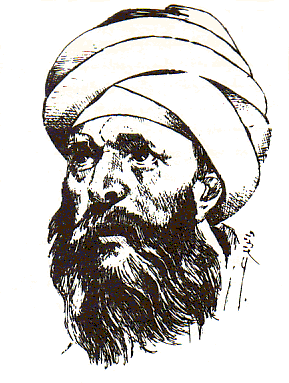
"Islamic ethics tends toward extreme theological voluntarism."

Qur'an, Ninth Century
إِنَّمَا قَوْلُنَا لِشَيْءٍ إِذَا أَرَدْنَاهُ أَن نَّقُولَ لَهُ كُن فَيَكُونُ
"For to anything which We have willed,
We but say the word, 'Be', and it is."
(Yusuf Ali, translator, Ayah 40, Qur'an)
Small Telyashayakh Mosque, Tashkent
(Image from Wikipedia)
The heading to this day's blog entry comes from an article by Daniel W. Brown.
You may recall that I cited him yesterday on Islamic divine voluntarism. Who, therefore, is Daniel W. Brown, and what are his credentials? According to Cultural Encounters: A Journal for the Theology of Culture, Dr. Brown has the following credentials:
Dr. Daniel Brown has lived in Egypt and in Pakistan where he was born and spent his first eighteen years. In 1993 he received his Ph.D. in Islamic Studies from the University of Chicago. He has been a visiting scholar at the International Islamic University in Islamabad, the Institute of Islamic Culture in Lahore, and Cairo University and has taught Islamic Studies at Mount Holyoke, Amherst and Smith Colleges.From this information, I'd say that Dr. Brown appears reputable and trustworthy.
Since 1997 he has been Pastor of Stony Brook Community Church in South Hadley, Massachusetts. He is the author of Rethinking Tradition in Modern Islamic Thought (Cambridge, 1999) and A New Introduction to Islam (Blackwell, 2003).
With that in mind, let me return to the passage that I cited yesterday, within the context of the passage in which it occurs:
Islam might be considered the defining case of ethical voluntarism. Among most Sunni Muslim scholars, past and present, voluntarism has been an undisputed assumption of Islamic ethical theory, finding reflection in Islamic credal formulations.Dr. Brown was writing this in 1999, two years prior to September 11, 2001, so he had no obvious axe to grind, and since he seems to have credentials and to be trustworthy, I see no reason to discount his presentation of the standard Sunni Muslim view of Allah's ethical directives as voluntarist and his treatment of Ibn Hazm's view as normative.We confess that the decision concerning good and evil wholly depends on Allah. For whoever should say that the decision regarding good and evil depends upon another than Allah would thereby be guilty of unbelief regarding Allah, and his confession of the unity of Allah would become invalid. (Wasiyat Abi Hanifa, art. 6. Cited in A.J. Wensinck, Muslim Creed: Its Genesis and Historical Development (London: Frank Cass & Co., 1965), 126)Ibn Hazm (d. 1064) offers the following stark elaboration of the majority position:If God the Exalted had informed us that he would punish us for the acts of others . . . or for our own obedience, all that would have been right and just, and we should have been obliged to accept it. (Ibn Hazm, al-fisal fi'l-milal wa-l-ahwa' wa-n-nihal, 5 vols. (Cairo, 1890-1903), 3:92. Cited in Hourani, Reason and Tradition in Islamic Ethics (Cambridge: Cambridge University Press, 1985), 174)As Ibn Hazm's statement implies, and as Hourani points out, Muslim theologians, including al-Ash'ari (d. 935), Ibn Hazm and al-Ghaziili (d. llll), did not shy away from the most extreme consequences of voluntarism: Should God have commanded theft and idolatry it would have been right for humans to commit them. (Hourani, Reason and Tradition, 59)
Ethical voluntarism reinforces and is reinforced by the general tenor of Ash'arite theology, with its characteristic emphasis on the overwhelming power and sovereignty of God at the expense of human freedom. In the words of a standard credal formulation: "Allah has created the creatures, who are devoid of power because they are weak and impotent, whereas Allah is their creator and their sustenance; as He says: 'It is God who created you, who fed you, who, later, will cause you to die, and then will make you alive'" (Wasiyat Abi Hanifa, art. 12, in Wensinck, Muslim Creed, 126). Voluntarism accords well with such a view of the overwhelming power of the creator and the utter dependence of the creature. Further, voluntarism grants to God complete freedom -- He is unbound by any external standard of good, evil or justice. (Daniel W. Brown, "Islamic Ethics in Comparative Perspective," The Muslim World, Volume 89, Number 2, April 1999, pages 183-4)
Now, this does not mean that a Muslim can do whatever he pleases, so I don't entirely agree with my friend Bill Vallicella's formulation of the problem:
The Muslim view is quite 'chilling' if one thinks about it. If God is not contrained by anything, not logic, not morality, then to use the words but reverse the sense of the famous Karamazov passage, "everything is permitted." In other words, if the Muslim god exists then "everything is permitted" just as surely as "everything is permitted" if the Christian god does not exist. In the latter case, everything is permitted because morality has no foundation. In the former case, everything is permitted because morality's foundation is in Absolute Whim.Although one can conclude from Islamic divine voluntarism that 'everything is permitted' to Allah, one cannot infer that 'everything is permitted' to those who submit to Allah. Muslims must follow Allah's ethical directives . . . whatever they happen to be.
To put it in another way, a foundation of morality in unconstrained and unlimited will is no foundation at all.
To 'feel the chill,' couple the Muslim doctrine about God with the Muslim literalist/fundamentalist doctrine that his will is plain to discern in the pages of the Koran. Now murder can easily be justified, the murder of 'infidels' namely, on the ground that it is the will of God. (William F. Vallicella, "Islam and the Euthyphro Problem," Maverick Philosopher, November 5, 2007)
As to precisely what Allah's ethical commands entail . . . well, that is the 72-virginal-houri question.
Labels: al-Ashari, al-Ghazali, Allah, Asharites, Daniel Brown, houri, Ibn Hazm, Islam, Qur'an, Sunni, Voluntarism, William F. Vallicella
posted by Horace Jeffery Hodges @ 3:48 AM
14 comments