Sunday, June 11, 2017

Radiant Snow: The Ewha Voice Interview

The Ewha Voice Interview

An article about my poetry book, Radiant Snow, is not yet online at the Ewha Voice website, so my wife photographed the entire article to enable me to reproduce it here for anyone interested.

The woman from the Ewha Voice who interviewed me was the reporter Cho In-hyo, and the photographer was Lee Young-in, and each did an outstanding job.

For those interested in reading the article, just click on the photographed page above.

Labels: , ,

Saturday, August 22, 2015

The Famous, Elusive Ida Perkins . . .

Jonathan Galassi
Wikipedia

In her review of Muse, Emily Rhodes admits: "Jonathan Galassi's fictional poet made me doubt my knowledge of American literature" (The Spectator, August 15, 2015). Here's why:
Jonathan Galassi is an American publisher, poet and translator. In his debut novel Muse, his passion for the 'good old days' of the publishing industry is palpable: a time when books were books, with glued or even sewn bindings, cloth or paper covers, with beautiful or not-so-beautiful jackets and a musty, dusty, wonderful smell . . . their contents, the magic words, their poetry and prose, were liquor, perfume, sex, and glory to their devotees . . . . Galassi energetically resuscitates this world, where manuscripts were packaged in 'neat gray or powder-blue boxes . . . or in battered manila envelopes if they were coming from writers without representation' . . . . Matching the author's passion for the heyday of publishing is his protagonist's obsession with a poet. Paul Dukach begins his bookish career with a Saturday job in a bookshop, where he is introduced to the poetry of Ida Perkins . . . and becomes expert on her work. After college he lands a job as an editor at a New York publishing house and cultivates a friendship with the head of a rival press, Ida's publisher, who invites Paul to study the notebooks of Ida's former lover . . . . Paul's investigations take him to Venice, where he meets Ida . . . . And what of Ida Perkins? Her final collection of poetry, published post-humously, becomes a bestseller in both print and ebook editions . . . . 'Ida was alive, as alive as anything . . . her message, her genius, had been handed on, not via biology, but through the DNA locked inside her syllables.' While many fall victim to this turbulent time in publishing, Galassi seems to suggest that talent, in the form of Ida, can weather the storm . . . . Throughout the novel . . . [Dukach] goes to great lengths to persuade his readers of her reality, and . . . I had to google Ida Perkins to double check there wasn't a colossal gap in my knowledge of 20th-century American literature. Galassi embeds his poet in American cultural history with a series of cameos, including meetings with Jackie Kennedy, Wallace Stevens and John Berryman, and appearances at Woodstock and on the cover of Rolling Stone . . . . He also quotes her poems, sometimes in their entirety, and ends the book with a faux bibliography of her work and related criticism. In going to such lengths to persuade us that Ida is 'alive' beyond his pages, Galassi perversely draws attention to the fact that she isn't. If Ida is the silver lining of the storm of the digital revolution, that lining is less convincing for being so emphatically fictional. Perhaps we are to infer that Galassi couldn't possibly use a real author in Ida's place, because no real poet would fare so well at the hands of Amazon.
Ida is alive - both electronically and in hard copy - while my little book survives on Amazon's life support, which, by the way, is a good thing, and some independent authors' works are doing quite well through Amazon publishing.

Labels: , ,

Friday, April 17, 2015

That Dread Time of the Year . . .

Time for Review

I'm coming up for review soon, so I was asked to offer a list of articles, stories, and poems I've published over the past academic year, and because making the list and copies of each document took so much time that I couldn't expend much remaining time on today's blog, I've decided to simply show interested readers the list:

Research Performance

Publications - Horace Jeffery Hodges, Ph.D.
2015 "The Uncanny Story," Emanations: 2 + 2 = 5, Edited by Carter Kaplan (Brookline, MA: International Authors, 2015) (Forthcoming in August).

2015 "The Peach/Apple in John Milton's Paradise Lost, Andrew Marvell's 'The Garden,' and T. S. Eliot's 'The Love Song of J. Alfred Prufrock': Etymology and Sin," The Journal of the Medieval and Early Modern English Studies Association of Korea, Volume 23, No. 2 (2015) (Coauthored with Salwa Khoddam) (Forthcoming in August).

2015 "Milton's Astronomy and the Seasons of Paradise: Queries Motivated by Alastair Fowler's Views," Connotations: A Journal for Critical Debate, Vol. 24, Number 1 (2014/2015), 88-104.

2014 "Horace Jeffery Hodges (poems)," Emanations: Foray into Forever, Edited by Carter Kaplan (Brookline, MA: International Authors, 2014), 263-266.

2014 "Literature and National Community: The United States and the Case of Stephen Vincent Benét" (Invited Speaker), Proceedings of the Byeng-ju Lee International Literary Festival 2014 (Hadong-Gun: Byeng-ju Lee Memorial Society, Fall 2014).

2014 "The Mis-Education of Horace Hodges" (Invited Speaker), Proceedings: Storytelling – Trauma, Healing, and Pedagogy (Seoul: Research Institute for Storytelling at Chung-Ang University, Fall 2014).

2014 Shin Chae-ho, Dream Sky, translated by Hwang Sun-Ae and Horace Jeffery Hodges (Seoul: Literature Translation Institute of Korea, Fall 2014).

2014 Yang Geon-sik, Sad Contradiction, translated by Hwang Sun-Ae and Horace Jeffery Hodges (Seoul: Literature Translation Institute of Korea, Fall 2014).

2014 "True Translation?" (Keynote Speech), The Role of Translators and Literary Agents in Globalizing Korean Literature, The 13th International Workshop for Translation and publication of Korean Literature, June 20, 2014 (Seoul: Literature Translation Institute of Korea, 2014).
I was surprised at the number when I'd counted them up, though some were merely published in the proceedings of some conference or such, so don't be impressed by nine publications.

Labels: ,

Tuesday, January 31, 2012

On the frontlines "of this great Argument" -- finding myself among the New Milton Critics!


There may be some interesting consequences stemming from my recent publication in the Milton Quarterly, for I suspect that I'll be perceived as having placed myself squarely in the camp of the New Milton Critics. Who are they? Three days ago, I couldn't have told you, but here's what they have to say for themselves:
The New Milton Criticism seeks to emphasize ambivalence and discontinuity in Milton's work and interrogate the assumptions and certainties in previous Milton scholarship. Contributors to the volume move Milton's open-ended poetics to the centre of Milton studies by showing how analysing irresolvable questions -- religious, philosophical and literary critical -- transforms interpretation and enriches appreciation of his work. The New Milton Criticism encourages scholars to embrace uncertainties in his writings rather than attempt to explain them away. Twelve critics from a range of countries, approaches and methodologies explore these questions in these new readings of Paradise Lost and other works. Sure to become a focus of debate and controversy in the field, this volume is a truly original contribution to early modern studies.

Among the New Milton Critics are Peter C. Herman, Elizabeth Sauer, Richard Strier, John Rogers, Judith Scherer Herz, Michael Bryson, Christopher D'Addario, Shannon Miller, Thomas Festa, Jeffrey Shoulson, William Kolbrener, and Joseph Wittreich, for these scholars contributed to the volume pictured above. I know several of them from the Milton List and also recognize the names of others from my acquaintance with Milton scholarship. I simply didn't realize that these trees made up a forest. I suppose I'm now perceived as a sapling on the perimeter. From the passage quoted above, I can see that I have some things in common. Like these scholars, I read Milton with a focus on "uncertainties in his writings," but unlike these same scholars, my approach to the uncertainties is to "attempt to explain them away," if possible. I don't embrace the uncertainties. I'm certainly no deconstructionist. I see the uncertainties -- or better, the contradictions -- as problems for Milton's great argument, and I think that he was aiming for logical coherence without entirely achieving it. But I know that I'll now be forever misunderstood as a New Milton Critic. Why? Here in the concluding sentence of my Milton Quarterly article -- immediately following my half-ironic remarks on Satan's necessary role in resolving an antinomy in Paradise Lost -- is why:
Milton has told us that his "great Argument" (1.24) does indeed "justifie the wayes of God to men" (1.26), but surely Milton did not intend a felix culpa, even if one might entertain destabilizing doubt at such contradictory complications . . . though merely sketching out the uncertain ramifications of such as these would go far beyond this brief essay and into realms of incertitude and ambiguity explored by Peter Herman, among others (cf. Sauer 15n1).

The citation is of Elizabeth Sauer in her "Introduction: The Art of Criticism," from Milton and the Climates of Reading: Essays by Balachandra Rajan (Toronto: University of Toronto Press, 2006), which Sauer also edited. Concluding in this manner would seem to put my stamp of approval on the New Milton Critics -- among whom Sauer belongs (see list of scholars above) -- though I was in fact implicitly thanking Peter Herman for reading my article as I reworked it and offering his useful advice about seeking out primary sources from the 16th and 17th centuries to make my point about such terms as "cropt" and "uncropt." No one other than Peter would recognize this implicit thank-you note, of course, but there's more. Peter Herman also has an article published in the same issue of the Milton Quarterly, and it immediately follows my own -- mine thus appearing to introduce his -- and launches into a spirited defense of the New Milton Criticism through a strong offensive attack on an apparently polemical opponent:
I am not going to tax the reader's patience by repeating John Milton's mistake in Eikonoklastes and giving a tedious, point-by-point rebuttal of every single statement David Urban makes in his recent diatribe against the New Milton Criticism.

I finished reading Peter's counter-critique and then sent him an email:
I just yesterday received my copy of December's Milton Quarterly, and I learned of the heated debate between David Urban and the New Milton Critics. Wow! I've only read your article but will get to those of Wittreich and Strier soon.

There is some unintended irony in the concluding sentence of my article, which immediately precedes your own, in that my positive reference to your work on doubt, contradiction, incertitude, and ambiguity would appear to have been intended as an introduction to your article -- and the two that follow. I wonder if I will face consequences . . .

Peter quickly replied:
I was also very pleased by the happy circumstance of the last line of your article leading into mine. That [plus other things] . . . makes this the NMC issue of MQ, I think.

I strongly suspect that Peter's right. This issue of the Milton Quarterly will be seen as the New Milton Critics' issue, and scholars will infer that I've placed myself squarely within that camp.

Oh, well, all publicity is good publicity . . .

Labels: , , ,

Sunday, January 29, 2012

Paradise Lost: "Fruit Uncropt and Fruit Cropt"

Milton Quarterly Logo

Yesterday, I was pleased to see that the Saturday mail service here in Seoul (actual delivery on Saturdays?) had brought my copy of the Milton Quarterly. I don't really have a subscription, but I was expecting to receive a copy because I've had an article published in it, "Fruit Uncropt and Fruit Cropt: Unnoticed Wordplay in Paradise Lost?" (Milton Quarterly, Volume 45, Number Four, December 2011, pages 252-257). Here's the opening paragraph:
In Paradise Lost 4.724-35, Adam and Eve together praise the creator for their happy love and his abundant blessings, which include the gift of trees bearing fruit that "uncropt falls to the ground" (4.731), and the innocent pair request offspring to share that fruitful abundance. Ostensibly in tension with this are the words of Eve in Book 9, for she there remarks on the many trees with "Fruit untoucht, / Still hanging incorruptible" (621-22), awaiting the hands of offspring yet unborn. The apparent contradiction between the words implying that unplucked fruit falls to the ground from the trees of paradise and that unplucked fruit hangs potentially forever on the boughs of those same trees also serves to bring into focus another apparent contradiction. In the prelapsarian garden, into which death has not yet entered, why should any fruit fall to the ground? Would that not imply death and decay? And what of the plucked fruit's uneaten portions? Are these tossed onto some prelapsarian 'compost' heap? Let us investigate this complex issue. (page 252)

If that interests you -- and it probably does not -- then rush over to the Wiley-Blackwell Website and order a copy! Some folks will be interested, I reckon, since the scholar Gordon Campbell, who edits Renaissance Studies, says, "If you want to publish to be READ, write for the Milton Quarterly." At the very least, I suppose Professor Campbell will read my article.

But even if not, I'm enjoying the rare pleasure of publishing an article in what is arguably the top Milton journal in the world.

Labels: , , ,

Saturday, October 10, 2009

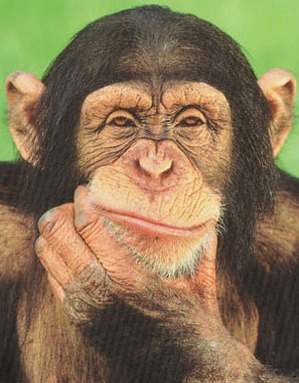
Bruno Littlemore says: "Ben Hale will go far."

Sentient Chimp of Semiotics
Borrowed from Nelson Kruschandl
(Image from Solar Navigator)

Well, I said it first: "Ben Hale will go far." I said it nearly a year and a half ago: "Out of the mouths of babes and sucklings . . ." At the time, my old high school chum Pete Hale had recently informed me that his son Ben -- whom I had last seen as an infant -- was writing a novel. According to Pete, the novel is "narrated first-person by a very wry old chimpanzee who turns out to have the chimp mutation tweek that pushes him over the edge into 'sentient'; he learns how to talk, read, write, becomes a famous semiotics professor."

Ben spoke of other ideas spinning out from the core of his thinking, including a possible PhD in linguistics and primatology concerning semiotics and great ape experiments intersecting with science and the philosophy of language. However, a PhD in anything would now be a step down, for a story -- an incredible story -- has developed since that blog entry last year, and my old friend Pete tells me a tale of a debut novelist's unlikely success. It started Friday, October 2, with Pete telling that Ben had finished at the University of Iowa and taken off for New York City in August, found himself a literary agent there, and had been fine-tuning his novel about the hyper-intelligent chimp named Bruno since then.

The Monday before that, Ben and his agent had sent out the manuscript and to their surprise had quickly received several offers. This sort of thing does not happen very often, so Pete was naturally very excited at Ben's good news and promised to let me know how things turned out after Tuesday, October 6th, when the negotiations were expected to conclude. I congratulated Pete on Ben's good fortune and promised to blog about the success when more was known. Several days passed, during which Pete kept me posted as various meetings were going on between Ben and various publishers -- both domestic and foreign. I finally received the go-ahead for an announcement after the official press release was posted by Rachel Deahl at Publishers Weekly on Friday the 9th around noon (Seoul Time) informing us that Twelve Publishers will publish the book, and since this press release supercedes much of what I had composed over the course of a week as I waited for the official news, I've decided to edit what I had previously posted and just go with what Deahl reports:
Closing a five-way auction just before the Frankfurt Book Fair, Brian DeFiore sold North American rights to The Evolution of Bruno Littlemore to Cary Goldstein at Twelve. The novel is 26-year-old Benjamin Hale's debut and is presented as the memoir of the first chimp to develop the ability to speak. DeFiore is championing the book as a potential buzz title at the coming fair.

Hale wrote the book at the Iowa Writers' Workshop and took home the Michener-Copernicus award for it this year. The novel is written from the perspective of the titular chimp, now looking back on his life after returning to captivity in the shadow of a murder conviction; DeFiore described the work, which clocks in at 600 pages, as a "sprawling novel." The agent said it touches on such themes as alienation, xenophobia, language and taboo desire; Twelve is planning an early 2011 publication.
Absolutely incredible. What a success story! Well . . . so far, but the proof will be in the proverbial pudding. I look forward to the published novel and hope to have equally impressive words to post in my own review.

If I like it . . .

Labels: , , , ,

Sunday, March 18, 2007

Some earthshattering minor details...

Now digital but still posing problems...
(Image from Wikipedia)

Well, the details shattered my small world. Let me explain.

Recently, I researched the theme of kinslaying in Beowulf and wrote an article -- titled "Cain's Fratricide: Original Violence as 'Original Sin' in Beowulf" -- that has now been published in Medieval and Early Modern English Studies 15.1 (February 2007). The journal, along with several offprints, arrived yesterday, and I was dismayed.

I'll explain why in my typically roundabout manner.

Round about the 20th of February, I received the penultimate, edited draft of my Beowulf article from Dongin Publishing Company for my last chance to proofread it. I found a few minor errors, mostly my own, corrected these, and returned the draft immediately. I was pleased with Dongin's professionalism, especially for the way that this publisher handled block quotes. Here's an example from my article:

Though Beowulf presents a world full of violence, a world repeatedly threatened by evil, nowhere does this epic poem even hint at the traditional story of the Adam and Eve's first sin and subsequent fall. Instead, we twice find references to the story of Cain slaying his brother Abel, whence come the evil, monstrous offspring that strive with God (ll 107-114), of whom Grendel seems to be one. Indeed, Grendel's violent intrusion into Heorot recalls that primeval intrusion of violence that ended the Golden Age:

[Grendel] intrudes into the narrative of Beowulf just as lord Hrothgar's poet is singing of the creation the world -- a bright song which begins with the shaping of the earth (91-2) and ends at its populating (97-8), before the introduction of original sin. Hrothgar's warriors are by conjunction immediately brought into this Golden Age ("Swá ðá drihtguman dréamum lifdon," "So the men lived in joy," 99), until Grendel suddenly intervenes. (Cohen, para. 3)
Cohen refers to creation's gentle moment penultimate to "original sin" in the poet's song, and the Beowulf text itself extends that gentle moment to include the time of Hrothgar's men living in joy until an act of original violence interrupts. This original violence committed by Cain is treated in the poem as a primeval act that explains all subsequent violence.
The Cohen reference is to Jeffrey Jerome Cohen's online article "Monsters, Cannibalism, and the Fragile Body in Early England" -- and I now see that some information was deleted in the citation, which should have read: Cohen, "Monsters" [Section: 'The Letter Killeth,' paragraph 3]. I hadn't noticed that when I proofread the edited draft, so that's my fault, I guess (but why would the publisher remove essential information?).

Anyway, I was quite pleased with the overall result, particularly for how block quotes were handled. Previously, I had encountered difficulties publishing in Korea because the publishers had always indented the line after a block quote. Thus, I expected to discover that Dongin had indented the line that begins with the words "Cohen refers to" because it follows the block quote of Cohen's statements on Grendel's intrusion into Hrothgar's idyllic community. The line, however, was quite properly un-indented.

I was so pleased with this small blessing that I complimented the publisher in the email of February 21st that I sent along with the attached, proofread manuscript of my article:

Dear Staff at Dongin Publishing:

Thank you for performing a job well done -- your editing work is among the best that I have encountered in my time here in Korea.

I have accepted corrections that were noted in red font, and I have made a number of other corrections myself. I hope that the resulting text will be acceptable. The alterations are not major.

Please let me know if there is anything else that you need from me.

Best Regards,

Jeffery Hodges
Alas, I wrote those words too soon, for when I opened the journal yesterday, what did I find but ... that feared, improper indentation following the block quote, as though the words "Cohen refers to" were the opening line of a new paragraph. Moreover, this error was pervasive in my article. Also in other articles ... but not all of the articles. For some reason, all of the articles by non-Koreans suffered from this error, while the articles by Koreans were correct. Why this should have happened totally mystifies me, and I'd like an explanation please.

Perhaps I'll even receive a reply, for I notified a Korean friend of mine who is a professor in a prominent Korean university, is a very good Medievalist, and is unafraid to inquire about the error. Here's what I wrote:
I just today received two copies of the journal Medieval and Early Modern English Studies, along with the offprints of my article on 'original sin' in Beowulf -- the one that you read and helped me on. Oddly, there were some changes in formatting that slipped in after my checking of the penultimate draft. For some reason, after each block quote came an indented line, as if a new paragraph were beginning.

Apparently, the program used for setting the pages for printing must have automatically indented (though only on mine, Skupin's, and Nokes's -- and possibly Brother Anthony's). This is not good, for it makes our final proofreading partly superfluous. Also, I had praised the printer for avoiding this very problem in the penultimate draft. My praise was premature.

This is not good, for it makes the journal look unprofessional. Can't the printer be told to watch for this problem? It happens rather often here in Korea, so publishers should be aware of the problem.

Sorry to complain, but perhaps you could relay the information.
I hope that my complaint will make the Dongin Publishing Company more careful in the future, but I won't get my hopes up too much since this problem occurs again and again.

Labels:

Saturday, November 11, 2006

Academic Adumbrates Umbrage

Academic Taking Umbrage
Is it he or me?
(Yes, I know that's ungrammatical.)
(Image from Free Dictionary)

Regular readers may recall my two posts on Milton's understanding of sacred in the "sacred fruit" that grew on the tree of knowledge.

The article that I was working on at the time has now been accepted by a journal and will soon be published. Of course, I had to make some changes -- and resist making others -- based on suggestions offered by three referees.

Most referees attempt a fair reading, but some merely pretend to. My second referee fell into the latter category, seemingly taking 'scholarly' offense at my article (and I've put the unjustified remarks in red font):

This paper is based on a etymological study of the word "sacred" used by Adam to describe the Tree of Knowledge in order to argue that 1) Adam is indeed expressing Milton's own view that the tree's fruit is originally sacred 2) that by "sacred," Milton seems to mean not the dynamic power of holiness but the holy as pure and set apart, whereas Adam's view on this point remains unclear and 3) Milton portrays the fruit as no longer sacred after its plucking but as "unhallowd" in the strong sense of being imbued with a force of impurity, a point that Adam fails to recognize.

I found the reading "chaotic," digressive, fractured and still unsure as to why something so obvious and limited in scope need even be discussed in a scholarly paper. Yet, I am going to suggest that it be published in this journal in the hope that others might discover gold where I only see pebbles.

The following corrections are suggested:

1) The abstract and keyword should go to the back of the article.
2) One question that comes to mind is what does the section on "Excursus: Chaos and Evil" have to do with the overall topic on Tree of Knowledge? It could be my lack of understanding or it could be that the author fail to make the connection in the paper: in which case, the author should either explain why the discussion on chaos is integral to the paper on the sacred nature of the Tree of Knowledge or delete it.
3) Are all the different versions of the bible and dictionaries listed in the Bibliography really necessary?
There it is, with the harsh remarks highlighted. I suppose that I owe this referee some modicum of gratitude for recommending publication, but I rather think a caning over the head more appropriate.

I accepted suggestion number one since I was going to do that anyway, but everything else in the review was objectionable -- aside from the recommendation that my article be published (an inexplicable recommendation, given the referee's critique, but I won't complain about that). For the benefit of the journal that had accepted my article (and possibly for the referee, to whom it might be forwarded), I penned a response, and here's what I wrote (with block quotes of the referee's words in red):
The second referee summarizes my article:

This paper is based on a etymological study of the word "sacred" used by Adam to describe the Tree of Knowledge in order to argue that 1) Adam is indeed expressing Milton's own view that the tree's fruit is originally sacred 2) that by "sacred," Milton seems to mean not the dynamic power of holiness but the holy as pure and set apart, whereas Adam's view on this point remains unclear and 3) Milton portrays the fruit as no longer sacred after its plucking but as "unhallowd" in the strong sense of being imbued with a force of impurity, a point that Adam fails to recognize.

My article is based on more than an 'etymological' study of the word "sacred," which is only one of the terms that I've subjected to philological investigation. Moreover, I use my investigation in an attempt to sketch Milton's system for organizing his concepts of the sacred, the common, the impure, and the pure and to apply this system toward explaining in what sense these terms are being used with respect to the fruit of the tree of knowledge, as well as to other, connected things such as chaos and creation and the topic of evil.

The second referee then characterized my effort as follows:

I found the reading "chaotic," digressive, fractured and still unsure as to why something so obvious and limited in scope need even be discussed in a scholarly paper.

I cannot dispute the "reader response" of this referee in finding my article "chaotic," "digressive," or "fractured" (though some supporting examples of these would have been helpful), but the referee surely did not intend to imply that my article is "still unsure."

Presumably, what was meant was that the referee was still unsure. But as for what was "so obvious and limited in scope" that it "need [not] even be discussed in a scholarly paper," the referee has left unspecified. I infer that the referee is referring to the three points summarized above, but I do not see that these are either "obvious" or "limited in scope." Perhaps the referee could have been more explicit, specifying, e.g., the obviousness of Milton's view that "sacred" in the expression "sacred fruit" meant "not the dynamic power of holiness but the holy as pure and set apart."

The second referee also suggests:

2) One question that comes to mind is what does the section on "Excursus: Chaos and Evil" have to do with the overall topic on Tree of Knowledge? It could be my lack of understanding or it could be that the author fail [sic] to make the connection in the paper: in which case, the author should either explain why the discussion on chaos is integral to the paper on the sacred nature of the Tree of Knowledge or delete it.

As noted above [in remarks related to referee number one], I open my excursus with these words: "The view that impurity is linked to the 'infernal' dregs of chaos touches upon an issue that has received some attention, namely, whether or not chaos is evil." The point is thus explicitly linked and has deeper connections for Milton's system of the sacred, the common, the impure, and the pure. The referee misunderstands my paper to be about "the overall topic on Tree of Knowledge," but it is actually about the sacredness of the tree and its fruit and the relation of this sacredness to Milton's larger system, including the question of where impurity comes from, which raises the issue of chaos and evil. At any rate, I have added the clarifying phrase noted above [i.e., in a response to referee number one: "The view that impurity -- and thus also the impurity of the fallen fruit -- is linked to the "infernal" dregs of chaos touches upon an issue that has received some attention, namely, whether or not chaos is evil"].

Another suggestion was made:

3) Are all the different versions of the bible and dictionaries listed in the Bibliography really necessary?

Yes, they are necessary, for I cite them in my article and therefore need to list them in a bibliography titled "Works Cited."

That this second referee failed to notice that I had cited these various dictionaries and Bible versions suggests a hasty reading of my article, an inference supported by what appears to have been a hastily written review.
That's what I wrote, and I hope that it reaches the referee's eyes. Fortunately, the other two referees liked my article. Here's part of what referee number three said:
This essay is quite strong in its close reading and its astute attention to the provenance and history of the major terms, and it no doubt works quite well at that level of philological scrutiny, which I believe this journal has a strong preference for .... [T]hree cheers to the vigilant philological labour; indeed, that alone is enough to grant the paper a space in this journal.
Referee number one also wrote some nice things, but if I posted them here, I'd have to translate them into English for most of my readers, so I'll just leave matters as they stand and hope that this blogpost has been at least mildly entertaining.

Labels: