Saturday, December 31, 2005

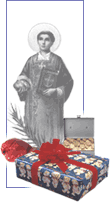
December 31: Feast Day of Pope Silvester I

When I first lived in Switzerland, way back in the winter of 1986, a certain Ms. D'aujourd'hui . . .

Yes, I realize that this sounds like the beginning of a dirty joke or an off-color escapade with some disreputable "lady of the night" . . . or "of the day" . . . but worry not. Ms. D'aujourd'hui really existed and was never involved with me in any untoward 'story.'

Indeed, she still exists, and if you Google her name, "Simone D'aujourd'hui," you discover that as recently as 2004, she was wishing someone a Merry Christmas and a Happy New Year:
19.12.2004 19:56: Simone D'aujourd'hui, Schaffhuuse

sali zämä, ich wünsche eu allne au gaanz schöni wiähnachte und en guete rutsch is 2005. shät üs gfalle bi eu und ich hoff dass me sich nögscht turnsaison mol irgendwo atrifft... liäbi grüäss vo dere us schaffhuuse mit em komische nochname!
Yes, that's a Swiss-German dialect -- except for the "turnsaison" Franglais. Note that she is quite aware of the strangeness of her "komische nochname."

Despite her unusual French name, Ms. D'aujourd'hui was a very Swiss-German young lady from the vicinity of Zurich, and since I was living with her Italian boyfriend in the university town of Fribourg, she happened to ask me what I would be doing on "Silvester."

I'd never heard of this holiday, and when I asked for an explanation, I learned two things.

First, it meant the same as New Year's Eve.

Second, it 'honored' the memory of the Pope Silvester who had held the Holy Office in the year 999, for he had expected the world to end at the onset of the millenium year 1000 A.D.

It didn't end, so everybody celebrated.

Thus today's New Year's celebrations.

Well, Ms. D'aujourd'hui had the first point correct, but as for the second point, I've had to un-learn that bit of crosscultural understanding.

The New Year's Eve Silvester celebration honors not the fascinating Pope Silvester II (999 - May 12, 2003) but the famously obscure Pope Silvester I (January 314 - December 31, 335), whose papacy is remembered for "little else than a record of the gifts said to have been conferred on the Roman Church by Constantine the Great."

Pope Silvester I is especially famous among historians for a very special 'gift' from Constantine that he didn't really receive: The Donation of Constantine.

According to this later, Medieval forgery, Constantine the Great granted Pope Sylvester I and his successors dominion over the entire Western Roman Empire. Medieval popes used this forged document in their attempts to assert secular authority over political leaders in Western Europe. The Italian Renaissance humanist Lorenzo Valla put a stop to that in 1440 when he proved the Donation a forgery by showing that some of the document's Latin had to have been written later than the fourth century.

According to a rather outrageous legend, the Donation was a gift of gratitude from Constantine because Pope Silvester I had cured him of leprosy by baptizing him in a bath of blood -- from which, we do NOT get the word "bloodbath."

But speaking of bloodbaths, Wikipedia adds the following disturbing bit of information:
According to Jewish tradition, January 1st, the day of the secular new year is known in Hebrew as Sylvester [Day] . . . named for Silvester I, who convinced the emperor Constantine to prohibit Jews from living in Jerusalem, and who arranged for the passage of anti-Semitic laws more than 1,700 years ago.
I don't know if this Jewish tradition about Silvester's role in barring Jews from Jerusalem or in passing anti-Semitic laws is historically accurate, but just in case it should prove accurate and thus implicate Silvester in the later bloodbaths to which Jews were subjected, let's raise our cups this New Year's Eve not specifically to Pope Silvester but to the New Year itself.

Friday, December 30, 2005

Culture of Discussion Needed in Korea

Yesterday's Korea Herald (December 29, 2005) has an interesting article on Joshua Park's goal of developing a culture of discussion in Korea.

Anyway, that's what I'm calling it since it's something that I've been calling for.

Yang Sung-jin, who interviewed Park for the Herald article, "Korean students urged to learn critical thinking through discussion," begins with the familiar complaint:
Korean students are said to excel in simple memorization, but often fail miserably when it comes to critical, creative and logical thinking.
We've heard this so often because it concisely states what many of us in the teaching profession have noticed.

In my opinion, the problem exists not just in the educational system but in Korean society as a whole because Korea lacks a culture of discussion, as I've previously argued.

So, how does Park intend to alter this? He proposes to teach discussion skills in class:
Park is actually teaching English discussion skills to his students, using the Socratic method -- the famous methodology of leading people to understanding through constant questioning and dialogue.

"I throw more questions than explanations during the class in a way that helps students see both merits and demerits of a certain issue. Eventually, students discover the problems and formulate their own opinions."
This sounds good to me.

Park also has a recently published book on this issue: Global Talent: The Answer Lies in Discussion (Nexus; 292 pages; 9,800 won), which I assume is a translation of the Korean title. My wife intends to take a look at Park's book in her next visit to downtown Seoul's Gyobo Bookstore -- and maybe also purchase Cho Se-mi's 세계는 지금 이런 인재를 원한다 (roughly translated: The World Wants Talent Like This), which treats this same subject.

Gypsy Scholar says: More of these and faster please.

December 30: Feast Day of Pope Sabinianus

Today's feast day honors a man whose name ought to ring a bell ... but probably doesn't.

Indeed, I haven't even found his birth name online, but if anybody knows it, please post a comment.

Anyway, the man we know as Pope Sabinianus began his papacy on September 13, 604 and ended it on February 22, 606. His time in the papal office followed that of Pope Gregory I, also known as Gregory the Great, whose known life has a lot more details than our man Sabinianus.

Still, we are stuck with today's man and must seek to do him justice.

In justice, then, it must be said that he strikes Gypsy Scholar as neither particularly competent nor especially popular.

Pope Gregory had sent him to Constantinople as Apostolic nuncio, or envoy, but he seems not to have performed his office there as well as desired. Though I don't know all of the details, the online Catholic Encyclopedia states that "He was not astute enough for the rulers of Byzantium," meaning (as I have learned since first posting this entry) that Pope Gregory found him lacking in competence and recalled him for being insufficiently "firm . . . with Patriarch John IV the Faster," who seems to have considered himself equal or superior to the pope. Sabinianus returned in 597 to Rome and somehow rose to the office of St. Peter when Pope Gregory died, so he must have been good for something.

Rodolfo Lanciani, in chapter 1 of his Pagan and Christian Rome (Boston and New York: Houghton, Mifflin and Company, 1892), citing the Liber Pontificalis (vol. i. p. 315), informs us that as pope, Sabinianus had no easy time, for during his short tenure of office, Rome faced a siege by the Lombard king Agilulf in 605 along with a poor harvest due to heavy frosts and rats. After paying Agilulf 12,000 solidi (gold coins of about 4.5 grams) to induce him to stop besieging the city, Pope Sabinianus opened the Church's granaries and auctioned the wheat at the rate of thirty modii (or pecks) per solidus -- to refill the Church's coffers, I suppose.

Lanciani adds that this was not a popular act, for the grain was intended not to be sold but to be distributed among the needy. Moreover, the price was "almost exorbitant," we are told, for grain is said to have cost only half as much in the time of Theodoric (meaning Theodoric the Great, 454-526?). While I would suggest that the law of supply and demand might account for some of the difference, I find myself overruled by Gregory the Great, who is said by Paulus Diaconus, in his Life of Gregory (chapter 29), to have appeared to Sabinianus in a vision three times, twice entreating him to act with more generosity but the third time returning to strike him dead.

Thus did the bell toll for Pope Sabinianus.

And appropriately so, for it is said that Sabinianus, through issuing a papal bull, was the first to have bells hung in turrets and rung to call the faithful to mass and to announce the seven canonical hours during which monks pray their daily prayers.

A related tradition attributes to him a command that sundials be placed on churches to show the hour of the day.

For these two things, at least, let us ring the Great Jubilee Bell above and raise our cups across the time zones in honor of a man otherwise obscured by time.

Thursday, December 29, 2005

December 29: Feast of St. Thomas à Becket

Most of us who study literature first learn of Thomas à Becket (1118? – 1170) from our initial encounter with Geoffrey Chaucer's fourteenth-century masterpiece, The Canterbury Tales, which tells the story of pilgrims telling their stories as they ride together on their way toward Canterbury to visit the shrine of St. Thomas à Becket, an archbishop who had been assassinated on December 29, 1170 by agents of the Norman king Henry II, as depicted in the image from an illuminated manuscript reproduced to the right.

A mere three years following this assassination, Becket was canonized by Pope Alexander III in 1173.

Supposedly, King Henry II had wished to have Becket done away with because of the latter's stubborn insistence on the right of the Catholic Church not to come under the jurisdiction of secular authorities.

Simply put, Becket held that the king couldn't tell the Church what to do.

One can understand why King Henry II might object to that.

In a replay of this state-versus-church issue during the reign of Henry VIII, all images of St. Thomas were ordered defaced, with the result that few portraits remain today. Henry VIII also ordered the dissolution of the monasteries between 1538 and 1541, and in that process, the shrine of St. Thomas was destroyed.

But the great, and the stubborn, leave their mark everywhere, it seems, for according to Wikipedia, "the word 'canter' came into the English language from the slow, leisurely pace of the horses" ridden by pilgrims heading for the Canterbury shrine of St. Thomas à Becket, the term "canter" being a shortened form of the longer original expression, "Canterbury gallop."

Oh, and lest I forget, let us raise a cup to the optional memory of this stubborn saint.

Wednesday, December 28, 2005

Lee Chul-ho's remarks

In a JoongAng Ilbo editorial yesterday (December 27, 2005), "Let Experiments repeat," Lee Chul-ho made the following remarks:
"This is truth. There is life on Mars," CNN reported a statement by the National Aeronautics and Space Administration (NASA) on August 6, 1996. It was the biggest discovery in the history of science that resulted from analyses of meteorites from Mars. Then-President Bill Clinton pledged, "We will concentrate all our ability and technology to exploring outer space." For nine years after that, NASA continued to send probes to Mars but failed to find evidence of any life. It turned out to have been a conspiracy by NASA aiming for trillions of dollars of the government budget and Bill Clinton aiming for re-election.
Lee then commented:
Professor Hwang Woo-suk's intentional falsification of his research paper is embarrassing but less so than the actions of NASA.
Interesting. America is always worse, I suppose . . .

But . . . I don't recall events quite as Lee does. I do remember scientists analyzing the meteorite from Mars and stating that certain structures and chemicals were consistent with the presence of life on the red planet, but I certainly don't recall NASA stating anything so direct as "This is truth. There is life on Mars."

I also recall nothing about this 'discovery' being a proven (or even rumored) conspiracy by NASA and President Clinton, who were (supposedly) aiming for trillions of supporting dollars and the presidential re-election, respectively.

Admittedly, I've been out of the country for over 15 years, so I might have missed that news.

Yet . . . if this concerned "the biggest discovery in the history of science," then I should have heard something.

Maybe I did hear, but it slipped my mind. Can somebody jog my memory?

. . . so that I can feel embarassed.

December 28: Holy Innocents' Day

The painting to the right presents Duccio di Buoninsegna's vision of the Slaughter of the Innocents (1308-1311). The painting hangs in the Tuscan city of Siena's Museo dell'Opera del Duomo, a medieval cathedral constructed between 1215 and 1263.

Hardly a day for celebration, Holy Innocents' Day commemorates the infants of Bethlehem that Matthew 2:16-18 reports King Herod ordering slaughtered in his attempt to kill the child (Jesus) that the three wise men had come to see because of a sign in the heavens announcing that a new king had been born in Bethlehem.

The Eastern Orthodox Church calls these infants the "first martyrs," displacing even St. Stephen from his otherwise preeminent place, but commemorates them on December 27th.

Nevertheless, December 28th is a Roman Catholic feast day, the one noted by Norman Boyer in yesterday's post as missing from Sir Gawain and the Green Knight after line 1022 but which, if present, must have depicted the lords and ladies feasting with wine, mirth, and singing.

We can perhaps raise at least a solemn glass.

Tuesday, December 27, 2005

Happy St. John's Day

When my six-year-old son, En-Uk, heard about the traditional twelve days of Christmas, he said, "I want to go to that place!"

We'd have to go back a few hundred years, I suppose, to a time when people actually celebrated the twelve days from December 25 to January 5 with continuous feasting, merrymaking, and giftgiving.

The 14th-century poem Sir Gawain and the Green Knight, for example, has King Arthur and his court celebrating the New Year with the giving of gifts, a tradition that the poem identifies in line 491 as "hanselle," using the Middle English term, of course.

Modern English returns to an older form, "handsel," which recovers the lost "d" consonant.

According to the Free Dictionary, the etymology is: "Old English handselen, a handing over (hand, hand + selen, gift) and from Old Norse handsal, legal transfer (hand, hand + sal, a giving)." This dictionary also provides as its first definition "1. A gift to express good wishes at the beginning of a new year or enterprise."

That fits the Sir Gawain usage, with its giftgiving on New Year's Day -- coming up this upcoming year on Sunday, so expect hangovers in church.

Today, however, we celebrate St. John's Day, which the Sir Gawain poet also mentions, in lines 1020-1026, which I borrow here from the printing edited by J.R.R. Tolkien and E.V. Gordon (Oxford: Clarendon Press, 1967):

Much dut watz þer dryuen þat day and þat oþer,
And þe þryd as þro þronge in þerafter;
Þe ioye of sayn Jonez day watz gentyle to here,
And watz þe last of þe layk, leudez þer þoghten.
Þer wer gestes to go vpon þe gray morne,
Forþy wonderly þay woke, and þe wyn dronken,
Daunsed ful drely wyth dere carolez.

The Norton Anthology of English Literature, Seventh Edition, Volume 1 (New York / London: Norton, 2000), edited by M. H. Abrams et al., provides Marie Borroff's modern translation:

That day and all the next, their disport was noble,
And the third day, I think, pleased them no less;
The joys of St. John's Day were justly praised,
And were the last of their like for those lords and ladies;
Then guests were to go in the gray morning,
Wherefore they whiled the night away with wine and with mirth,
Moved to the measures of many a blithe carol;

Modern scholars of the poem note a problem with the poem's chronology at this point and following, as explained by Norman Boyer of Saint Xavier University:
The dates get confusing at line 1020, since one day seems to be omitted. "That day and all the next" of line 1020 refer to Christmas day and December 26 (St. Stephen's Day). "St. John's Day" of line 1022 is December 27. What appears to be missing, according to the poem's most recent editors, is a line or two after line 1022 referring to December 28, Holy Innocents' Day, the last of the three major feasts following Christmas. Thus "the last of their like for those lords and ladies" (line 1023) would refer to the "joys" of December 28, and the guests would "go in the gray morning" (line 1024) of December 29 (which in England is the Feast of St. Thomas à Becket, murdered in Canterbury Cathedral by associates of King Henry II on Christmas Day 1170). The three days described in Part 3 are thus December 29, 30, and 31, and at the beginning of Part 4 Gawain leaves for the Green Chapel on January 1.
Whatever the eventual solution to this problem, the lords and ladies at the court of the Green Knight bring their celebrations to a halt rather sooner than did King Arthur's court above, but perhaps they were simply returning to their own courts for further festivities. The poem does not say, but given the traditional twelve days of Christmas, we would expect continued celebrations -- replete with ten lords a-leaping and nine ladies dancing.

Finally, for those of you patiently awaiting or impatiently a-leaping, here's something on St. John's Day, courtesy not of the courtly Sir Gawain but of Catholic Culture:

St. John's Day was a general holy day in medieval times, not only as the third day of Christmas but also in its own right (as the feast of an Apostle). The significant part of the traditional celebration was the blessing and drinking of wine, called the "Love of St. John" (Johannesminne; Szent János Aldása) because, according to legend, the Saint once drank a cup of poisoned wine without suffering harm. The prayer of this blessing can be found in the Roman Ritual (Blessing of Wine on the Feast of Saint John the Evangelist). In central Europe people still practice the custom of bringing wine and cider into the church to be blessed. Later, at home, some of it is poured into every barrel in their wine cellars.

People take Saint John's wine with their meals on December 27, expressing the mutual wish: "Drink the love of Saint John." It is also kept in the house throughout the rest of the year. At weddings, bride and bridegroom take some of it when they return from the church. It is also considered a great aid to travelers and drunk before a long journey as a token of protection and safe return. A sip of Saint John's wine is often used as a sacramental for dying people after they have received the sacraments. It is the last earthly drink to strengthen them for their departure from this world.

All this emphasis upon wine resonates with the wine mentioned in line 1025 of Sir Gawain. Perhaps wine was originally mentioned twice in that Gawain passage, first in connection with St. John's Day and then in connection with the imminent departure of the guests, which may have led the copyist's eye (and therefore hand) to inadvertently skip the (putative) lines on Holy Innocents' Day.

While we muse on that, let us honor St. John the Evangelist with a drink.

Monday, December 26, 2005

Happy Boxing Day

Cynic that I am, I have long celebrated Boxing Day as feast day for that patron saint of boxers, Saint Pugnacious, but doggonit, I've been utterly wrong.

Although Saint Pugnacious, whose life is celebrated in one cycle of the Medieval mystery plays, was just as real as Saint Christopher, neither the former nor the latter were fully human, which perhaps excludes them from authentic sainthood.

Be that as it may, Boxing Day is not held in honor of the pugilistic Saint Pugnacious, as Fact Monster makes clear:
Despite its name, Boxing Day, which is celebrated on December 26 in Great Britain, has nothing to do with pugilistic competition.
In fact, Boxing Day has something to do with . . . boxes. Unfortunately, nobody quite knows what.

As one who thinks outside of the box, I suggest that since December 26th is elsewhere celebrated as Saint Stephen's Day, then Boxing Day must be a holiday invented by the Puritan regime during the English Civil War to 'box up' and hide yet another Catholic saint.

I say we let Stephen back out of his box. In honor of that first martyr, Saint Stephen, who died by stoning, I move that we rename Boxing Day.

Let's call it "Stoning Day."

Sunday, December 25, 2005

Merry Christmas

Time for most of you on the slow, lagging side of the International Date Line to read that bedtime story, "The Night Before Christmas."

As for me, I got up so early this Seoul Christmas morning that I actually encountered old St. Nick himself squeezing his round body through the tiny exhaust pipe that sticks out the window from our clothes dryer!

I lied. We don't have a clothes dryer . . . though we surely could use one for Christmas.

But I swear that I did get up early enough to catch Santa flying off from Seoul! Moreover:

. . . I heard him exclaim, ere he drove out of sight,
"Happy Christmas to all, and to all a good-night."

A very merry Christmas from Gypsy Scholar.

Hwang's "Artificial Mistake" Revisited

In Saturday's edition of the International Herald Tribune, I finally found an English translation of the odd linguistic construction (een-oui-juhk sheel-soo, 인위적 실수) that Hwang Woo-suk used to describe the incorrect data in his 'groundbreaking' paper published in the May 2005 edition of Science: "human errors."

The offline IHT passage, found in the article "Cloning research ruled 'fabrication,'" by Choe Sang-Hun, appears in the online Friday edition as "Research in cloning declared a fabrication," where Choe Sang-Hun shares authorial honors with Elisabeth Rosenthal:
Although Hwang has retracted his paper from the Washington-based journal Science, citing "human errors," Roe Jung Hye, dean of research affairs at Seoul National University, said at the news conference that the erroneous data "were not accidental mistakes, but were an intentional fabrication."
Most native speakers of English would pass right over the expression "human errors" without a pause since English has the conventional expression "human error" to describe mistakes that human beings make (as distinct from those made by demons, computers, or other postlapsarian creatures).

A careful reader, however, might pause over the plural "errors," which sounds a bit odd . . . at least to me.

And well one might pause, for "human errors" doesn't quite capture the nuance that Hwang expressed. As I previously noted -- spurred on by my wife -- Hwang formulated an ambiguous construction:
Hwang used this expression [인위적 실수] -- which means something like "artificial (인위적) mistake (실수)" -- to describe his decision to publish his 2005 article before obtaining all the necessary data. Specifically, he was referring to the fact that he had fabricated the data for some stem cells to add to those that he claimed to have truly derived, thus making up the eleven cited in his article.
I then asked knowledgeable readers if the expression een-oui-juhk sheel-soo (인위적 실수) means "artificial mistake" or perhaps "intentional mistake." Two such readers emerged with helpful information.

David Choi wrote, "In-Wee-Juk Shil-soo means intentional mistake. I don't know about artificial." To this, Noirum added a more elaborate explanation:

The literal interpretation of 인위 (or 人爲 in Hanja) is "man-made," which may mean either intentional, artificial or even "human," depending on the situation. By the way, there's a separate word for "artificial" in Korea, which is "인공(人工)" meaning "man-crafted."

[I]n this instance, I agree with David's explanation, because most Koreans interpreted Hwang's word as "intentional."

Hwang deliberately played on words to elude his falsification and make his artificial and intentional misconduct to look like even a "human mistake" to his sympathizers.

Noirum's information is very helpful. I showed it to my wife, who read it and nodded in agreement.

The expression een-oui-juhk sheel-soo (인위적 실수) doesn't easily translate and retain its ambiguity. The translation "intentional mistake" emphasizes that the error was no accident, which isn't quite what Hwang wanted to admit. At the same time, Hwang didn't want to use an expression that could only mean a "purely accidental mistake" since he probably didn't want to suggest any incompetence on his part and, in any case, was already partly admitting to having fabricated some data -- albeit data that he claimed to have truly established after submitting his paper for publication.

IHT journalist Choe Sang-Hun chose to take een-oui (인위) as "human" and translate een-oui-juhk sheel-soo (인위적 실수) as "human errors," perhaps choosing the plural "errors" to suggest that Hwang's expression was not quite idiomatic.

Whatever Hwang might have been trying to say or not say, we can describe what he really did as Roe Jung Hye put it: "intentional fabrication."

But I wonder how she put it in Korean . . .

Saturday, December 24, 2005

My first irate commenter!

Or maybe he's just annoyed. Or mildly put out. Or even agreeing with me. I'm not sure.

The comment came in response to my post on "Hwang Woo-suk's Accusation," in which I analyzed Hwang's accusation that someone on his team with connections to MizMedi had stolen his patient-specific stem cells and replaced them with stem cells derived from fertilized ova stored in the MizMedi Hospital . . . or some such argument.

Here is the Korea Times translation of Hwang's words:

"I believe that one of my collaborators, who had access to both the laboratory at Seoul National University and the Mizmedi hospital, switched the stem cell lines. I would welcome a probe by prosecutors to look into this."
Yesterday, December 23, Hwang was still making this accusation and had even filed a lawsuit.

Despite Hwang's lawsuit, I still find this accusation impossible to take seriously. My December 18th post on Hwang's accusation speculated on the sort of scenario required for Hwang to be telling the truth:

If I let my imagination run wild, then I can imagine an outlandish scenario. Suppose that some collaborator wants more glory, unshared with Hwang. Solution? Destroy Hwang's reputation and use Hwang's "efficient" technique to develop patient-specific stem cells of one's own.

Such a 'plan' would be crazy, certain of failure since as soon as the erstwhile collaborator developed patient-specific stem cells using a special, efficient technique, the scientific community would call for an investigation and the general Korean public would call for the collaborator's head.

Since I found this implausible, I considered a different scenario:

Far more likely is a scenario in which Hwang himself uses MizMedi stem cells to develop stem-cell lines and then claims to have made patient-specific stem cells.

But isn't that plan equally mad, equally certain of failure? No, it isn't.

Suppose that Hwang was certain that he was close to a breakthrough in developing a new, efficient technique for making patient-specific stem cells. Suppose also that he was worried that some other scientific team elsewhere in the world might develop the technique first, a plausible concern given the high stakes, e.g., scientific honors, an assured career, more-than-sufficient research funding, and a possible Nobel Prize.
Such were my thoughts, in which I gave Hwang some credit for thinking himself close enough to success to cheat just enough to succeed.

My anonymous commenter's reaction was as follows:

What happen to the rest of the co-author? No one question them . . why only Dr Hwang is the sole author biting the bullet? Why the dramatic whinging from Roh and crocodile tears from Schatten? There is simply too much politics. People who knew Korean culture know that Politics play a major role apart from Money!!

Don't talk about ethics when the are double standard in America and other parts of the world.

Majority of the people want to know the truth and to find it is simple. Replicate the experiment. What's the problem. Good thing the patent was filed. In case you wonder . . I stand on the side of science.
I replied as follows:

Anonymous, I suppose that your point is that everybody involved in this scientific fraud needs to be questioned and the full truth established.

If so, I agree.

But if I've misunderstood you, please clarify.

As for the "patent," I assume that you mean a patent on Hwang's technique. I wonder if there really is a special technique. I doubt that Hwang ever cloned any stem cells. My wife doubts this, too, and she thinks that many other Koreans doubt it as well.

On this point, however, we'll just have to wait and see where the investigations lead.
I was going to leave my response at that, but I think that I should say more.

First, I'd like a clarification. What, precisely, is meant by this:

People who knew Korean culture know that Politics play a major role apart from Money!!
I suspect that the commenter -- who I'm assuming is a Korean with English as his second language -- has misused "apart from" and has meant "along with," "in addition to," or some similar expression, but I would certainly welcome further explanation here.

Second, on the "[d]on't talk about ethics" remark, I suppose that I could point out that I didn't actually talk about ethics. But that would be beside the point because I do think that I can talk about ethics if I want to. Indeed, everybody ought to be talking about ethics in this case.

If I want to be generous in my reading of this remark about ethics, then I suppose that the commenter might be objecting to my not having criticized Roh or Schatten. It's true that I haven't spent nearly as much time on them as on Hwang, but I have, in fact, criticized them, too.

Third, when the Anonymous commenter says, "Replicate the experiment," then I agree -- let's try that. According to Bo-mi Lim, "South Korean Stem-Cell Researcher Resigns" Associated Press (December 23, 2005), Hwang still claims to have a special technique:

Hwang still maintained that he had produced the technology to create patient-matched stem cells as he claimed in a May article in the journal Science.

"I emphasize that patient-specific stem cells belong to South Korea and you are going to see this," said Hwang, a veterinarian.
If he has the technique, then as my anonymous commenter points out, replication should be easy. "What's the problem[?]," my commenter asks, implying that there shouldn't be any problem.

Right. There shouldn't be any problem. So, why is there a problem? Why did Hwang have to cheat? If Hwang has developed such an effective, efficient technique for deriving pluripotent, patient-specific stem cells by inserting somatic DNA into an ovum whose nucleus has had its genetic materials removed, then why did he need to fake photos? Why didn't he just derive new stem cells using his wonderful method?

I say because he can't. He doesn't have a special technique, and even if he has managed to derive one or two patient-specific stem cells (which remains to be proven), then he has used hundreds of ova to do so.

Nothing special about that.

Hwang can keep his patent.

Friday, December 23, 2005

Hwang's "Artificial Mistake"

My wife told me that some Koreans have been discussing Hwang Woo-suk's linguistic skills, including his ability to coin new expressions, such as:

인위적 실수

Hwang used this expression -- which means something like "artificial (인위적) mistake (실수)" -- to describe his decision to publish his 2005 article before obtaining all the necessary data. Specifically, he was referring to the fact that he had fabricated the data for some stem cells to add to those that he claimed to have truly derived, thus making up the eleven cited in his article.

I'm curious about this expression and how it has been translated in English-language reports. I don't recall seeing anything in news reports on the Hwang debacle referring to Hwang's "artificial mistake" . . . or even, perhaps, his "intentional mistake"?

Any suggestions?

Ode to Ale Revisited

Yesterday, I posted an anonymous drinking song from the 15th century and openly wondered about its 'modern' appearance in my Norton Anthology, asking if the text had "been modernized in its spelling and vocabulary."

I felt pretty sure about the former but unsure about the latter.

Pose a question on the internet, and someone will answer it sooner or later. Yesterday's answer came sooner than expected.

Ian Myles Slater, who seems to be something of a Renaissance Man online -- do a Google of his name, and you'll find that he has a wide range of interests -- posted a useful comment:

Quiller-Couch's "Oxford Book of English Verse" (1919) confidently attributed the poem to a William Stevenson (1530?-1575). Norman Ault was less certain in the anthology "Elizabethan Lyrics" (1940), which gives an old-spelling text (page 41). The fifth edition of "The Norton Anthology of English Literature" (which I have at hand) treats it simply as Anonymous (pages 994-995).

In any case, it appeared in the pioneering play "Gammer Gurton's Needle" (by "Mr. S., Master of Art," which is where the speculation about authorship seems to come in). It may be indefinitely older. But the language of that 1575 text is certainly VERY post-Chaucerian.
In a later comment, Slater provided access to an online copy of Gammer Gurton's Needle, which presents the text of the song in its second act (The. ii. Acte. Fyrste a Songe.) as follows:

Backe and syde go bare, go bare, booth foote and hande go colde:
But Bellye god sende thee good ale ynoughe, whether it be newe or olde.

I Can not eate but lytle meate, my stomacke is not good:
But sure I thmke that I can drynke with him that weares a hood.
Thoughe I go baretake ye no care, I am nothinge a colde:
I stuffe my skyn so full within, of ioly good Ale and olde.

Backe and syde go bare go bare, booth foote and hand go colde:
But belly god send the good ale inoughe whether it be new or olde.

I loue no rost but a nut browne toste and a Crab layde in the fyre,
A lytle bread shall do me stead much breade I not desyre:
No froste nor snow, no wnde I trowe can hurte mee if I wolde,
I am so wrapt, and throwly lapt of ioly good ale and olde.

Backe and syde go bare go bare, booth foote and hand go colde:
But belly god send the good ale inoughe whether it be new or olde.

And Tyb my wyfe that as her lyfe loueth well good ale to seeke,
Full ofte drynkes shee tyll ye may see the teares run downe her cheekes:
Then dooth she trowle to mee the bowl eeuen as a mault worme shuld,
And sayth sweete hart I tooke my part of this ioly good ale and olde.

Backe and syde go bare go bare, booth foote and hand go colde:
But belly god send the good ale inoughe whether it be new or olde.

Now let them drynke tyll they nod and winke, euen as good felowes shoulde doe
They shall not mysse to haue the blisse, good ale doth bringe men to:
And all poore soules that haue scowred boules or haue them lustely trolde,
God saue the lyues of them and theyr wyues whether they be yonge or olde.

Backe and syde go bare go bare, booth foote and hand go colde:
But belly god send the good ale inoughe whether it be new or olde.
If you happen to check the text, you'll see that immediately following this song, two characters appear:
"Enter: Diccon. Hodge."
Hodge? That's close enough to my family name to warrant a raised cup . . . (glance at clock) . . . but perhaps not at 5:15 in the morning. Somebody in a different time zone will have to handle that honor.

But back to the issue at hand. It seems that by my post yesterday, I have happened upon a mystery concerning not just the poem's form but also its authorship.

Life, though, is short, and art is long, so I may never personally follow up the mystery of this poem, whether it be Late Medieval or Early Modern.

I do want to note, however, that the title given in my Norton Anthology, "Jolly Good Ale and Old," does not appear in the play "Gammer Gurton's Needle," which simply calls it a "Song." Slater knows it as "Back and Side" -- though perhaps merely as an idiosyncratic means of filing it away in his mind.

Choosing a title, by the way, does a lot to set the song's tone. The Norton title suggests good old times drinking, devil take the consequences! Slater's title lends itself to moral musings on the evil consequences of riotous living. The play's reference to it simply as "Song" leaves the meaning up to our own inclinations, be they righteous or riotous.

As for me, being of two minds about it, I'd limit myself to an if-by-whiskey speech.

What's an if-by-whiskey speech? Ah, you're not from the South, are you? Well for those of you still curious, here from the "November 2004 Archives" of Wordcraft is the explanation . . . and, even better, the prime example:

if-by-whiskey speech – southern US regionalism: a speech coming down emphatically on both sides on an issue

From the days when any good southern politician had a speech of this sort at the ready, concerning his views on spiritus ferminti. Several such passages are of record, of which this is the best. Supposedly from a Mississippi legislator in 1958.

"You have asked me how I feel about whiskey; well, Brother, here's how I stand.

If by whiskey you mean the devil's brew, the poison scourge, the bloody monster that defiles innocence, dethrones reason, destroys the home, creates misery and poverty, yea, literally takes the bread from the mouths of little children; if you mean that evil drink that topples Christian men and women from the pinnacles of righteous and gracious living into the bottomless pits of degradation, shame, despair, helplessness, and hopelessness, then, my friend, I am opposed to it with every fiber of my being.

However, if by whiskey you mean the oil of conversation, the philosophic wine, the elixir of life, the ale that is consumed when good fellows get together, that puts a song in their hearts and the warm glow of contentment in their eyes; if you mean Christmas cheer, the stimulating sip that puts a little spring in the step of an elderly gentleman on a frosty morning; if you mean that drink that enables man to magnify his joy, and to forget life's great tragedies and heartbreaks and sorrow; if you mean that drink the sale of which pours into our treasuries untold millions of dollars each year, that provides tender care for our little crippled children, our blind, our deaf, our dumb, our pitifully aged and infirm, to build the finest highways, hospitals, universities, and community colleges in this nation, then my friend, I am absolutely, unequivocally in favor of it.

This is my position, and as always, I refuse to be compromised on matters of principle."
I wholeheartedly concur.

Thursday, December 22, 2005

Ode to Ale

Enough of Hwang! Let's have a drink!

Now, this ain't my own composition -- my drinking song's here -- but an anonymous lyric of the 15th century will do the job just as well:

Jolly Good Ale and Old

I cannot eat but little meat,
My stomach is not good;
But sure I think that I can drink
With him that wears a hood.
Though I go bare, take ye no care,
I nothing am a-cold;
I stuff my skin so full within
Of jolly good ale and old.

Back and side go bare, go bare,
Both foot and hand go cold;
But, belly, God send thee good ale enough,
Whether it be new or old.

I love no roast but a nut-brown toast,
And a crab laid in the fire;
A little bread shall do me stead;
Much bread I not desire.
No frost nor snow, no wind, I trow,
Can hurt me if it would,
I am so wrapped and throughly lapped
Of jolly good ale and old.

Back and side go bare, go bare,
Both foot and hand go cold;
But, belly, God send thee good ale enough,
Whether it be new or old.

And Tib, my wife, that as her life
Loveth well good ale to seek,
Full oft drinks she till ye may see
The tears run down her cheek.
Then doth she troll to me the bowl,
Even as a maltworm should,
And saith, "Sweetheart, I took my part
Of this jolly good ale and old."

Back and side go bare, go bare,
Both foot and hand go cold;
But, belly, God send thee good ale enough,
Whether it be new or old.

Now let them drink till they nod and wink,
Even as good fellows should do;
They shall not miss to have the bliss
Good ale doth bring men to.
And all poor souls that have scoured bowls
Or have them lustily trolled --
God save the lives of them and their wives,
Whether they be young or old.

Back and side go bare, go bare,
Both foot and hand go cold;
But, belly, God send thee good ale enough,
Whether it be new or old.
I could have used this song back in my undergrad daze. I mean days. Well . . . okay, I mean both.

But some notes are needed, by which I mean footnotes -- though the musical notation would be useful, too. (How does one sing this song?)

I'll supply the footnotes, borrowed from page 30 of my Norton Anthology of Poetry (New York / London: Norton & Co., 1983), edited by Alexander W. Allison et al., but in my own informal way.

The lines about drinking with "With him that wears a hood" might raise the specter of the Ku Klux Klan in the mind's eye of Americans, but it actually means that the singer can drink "as much as any friar."

The "nut-brown toast" was "[u]sed as a sop with ale or wine," which reminds me of the spiced toast used for flavoring a drink -- a practice that I noted in my "Toast of the Town" entry some months back.

The "crab laid in the fire" doesn't allude to a seafood delicacy rather at odds with this singer's usual eating habits but to the crab apple, which derives its name from its sour flavor (recall that a sour person is "crabby"). Hence the need to cook it in the fire.

In case anyone needs help with "do me stead," it means "do me service."

The interjection "I trow" means "I trust."

The adverb "throughly" means the same as our modern-day "thoroughly," and the immediately following expression "lapped of" means "swathed in."

The word "troll" (and forget not "trolled") means "pass," which I never would have guessed on my own, but I suppose that it has some connection to a couple of the definitions given by the Free Dictionary for "troll":

(transitive verb): 3. Music: a. To sing in succession the parts of (a round, for example).

(intransitive verb): 4. To roll or spin around.
The image of passing a stein of ale around comes to mind.

Finally, a "maltworm" is a "toper." But what's a "toper"? Back to the Free Dictionary, entry for "toper": a chronic drinker. The word is pronounced with a long "o." Probably, you knew that.

As noted above, this drinking song stems from the 15th century, yet for a lyric from only about a century after Chaucer, it seems remarkably contemporary in its form of English, at least to me. Has it been modernized in its spelling and vocabulary?

Anyway, next time you're drinking an ale, try thinking a while on that unknown man some five hundred years ago who sat down with a brew and wrote this song.

And raise a cup in his honor.

Wednesday, December 21, 2005

The Hwang Woo-suk Debacle: Why Koreans Should Debate

Professor Jae C. Chang, of the School of Medicine at the University of California at Irvine, has written an interesting article in today's Korea Herald criticizing Hwang Woo-suk, "Hwang and his team's misconduct" (December 21, 2005).

More on that in a moment.

But first, if "University of California at Irvine" sounds familiar, then you've been paying attention to the Hwang debacle. Irvine is where Schatten had a brush with a similar scandal a decade ago, as Rick Weiss's article, "Donor Issue Slows Stem Cell Progress," in the November 20, 2005 edition of The Washington Post reminds us:
This is not the first time Schatten has found himself in the penumbra of an egg scandal. Ten years ago, revelations about criminal practices at a University of California fertility program led investigators to Schatten, who was then at the University of Wisconsin. He had an arrangement to obtain eggs from the clinic in Irvine, Calif., where, it turned out, doctors were impregnating women with embryos made from other women's eggs and distributing excess eggs to researchers without institutional approval.

One Irvine doctor was eventually convicted on federal charges, and two others fled the country to avoid prosecution. Schatten was cleared of any wrongdoing.
One can understand Schatten's desire to quickly dissociate himself from Hwang, but he bears a large degree of responsibility for putting him name on the article without carefully checking its data.

One can also understand why Chang -- knowing what happened at Irvine ten years ago -- is calling for strong punishment now of Hwang and his research associates:
The Pandora's Box is wide open and the world is watching. And the international scientific community is watching and waiting. It is the time for the Korean scientific community [to] take ... an appropriate step, which is a difficult and painful one but is a clear choice. That is to make timely and fitting sanction and punishment to the entire cadre of involved individuals for their offense to the science, to Korean people, to international scientific community, and to Korean society.
I'll join Chang's call for punishment if it means as soon as the investigation has finished its work and we know exactly what happened.

I am somewhat puzzled, however, by Chang's caution on related issues:
It is not the time to debate the right or wrong of the contents of the published article, whether or not Dr. Hwang's team has patient-specific stem cell lines, or which claim between Dr. Hwang and Dr. Roh is more correct, etc. in the media. It is not the time media prints inflammatory stories and promotes the blame games and prints hearsay of those from involved and uninvolved persons. It is not the time for Korean people to irresponsibly debate this debacle through cyberspace. And it is not the time for Korean government, Korean policymakers, and Korean politicians to mediate this debacle.
While I agree that the Korean media and the public shouldn't debate irresponsibly, I think that they should be responsibly debating such things as Hwang's articles, Hwang's data, and Hwang's purported lies.

As I've mentioned previously in this crisis, I think that this is a teachable moment in Korea. I'd like to hear from the younger Korean scientists whom Chang praises:
I am seeing a huge hope for young, budding Korean scientists who have had the intelligence, knowledge and courage, and above all the desire to find "truth" that is science.
I assume that Chang means those younger Korean scientists who are reported to have been posting criticisms of Hwang's research methods for several months now and continue to post. Their spoken but unheard critique of Hwang should now be listened to in the public debate and help to bring about a cultural shift in Korean thinking on the rights of younger people to openly question their elders in civil discourse without fear of reprimand.

Such might enable Korea to develop a much-needed culture of discussion.

The other "Dr. Hwang"

According to Cho Jin-seo, "Panel to Issue First Report on Hwang's Paper," reporting in the online Korea Times, we'll soon be learning the results of SNU's investigation of Hwang:
A team of scientists organized by the Seoul National University will announce as early as Thursday the outcome of its initial investigations into allegations that Prof. Hwang Woo-suk fabricated his landmark stem cell research.
Thursday. December 22. From where I sit in Seoul, that's tomorrow. Readers on the other side of the International Date Line will be momentarily confused.

I understand.

I'm still uncertain what weekday the 9/11 attacks occurred. Reports always speak of the beautiful blue sky that bright morning, but for me, the attack took place in the dark evening while I was teaching a course at Hanshin University to graduate students taking a night class.

I thus missed the immediate impact (so to speak) and only caught news reports during the aftermath, as I was putting my two-year-old son to sleep and happened to see the news reports that came on when his Pingu video went off.

This time around with the earth-shaking news, my son is old enough to notice that my wife and I have been talking about a certain "Dr. Hwang." My nine-year-old daughter is also listening and asking lots of questions.

Why? Um . . . it's personal, sort of. Let me explain.

Korean culture has the custom of allowing the wife to maintain her maiden name, and we've followed that custom.

My wife's family name is "Hwang."

She has a doctorate.

She is "Dr. Hwang."

The other "Dr. Hwang."

My children have thus looked a bit worried to hear me talk about "the deplorable Dr. Hwang" so often that "Hwang" has come to sound as wrong as a "deplorable word" that ought to be locked away in a wardrobe somewhere.

They also feel directly affected because my wife and I gave them her family name.

They're two little Hwangs.

A name like this one can give rise to all sorts of unfortunate jokes, and I'm not above making one or two myself.

Suppose that Sa-Rah hits En-Uk and I reprimand her, only to hear "He hit me first!"

I can retort: "Two Hwangs don't make a right!"

Okay, that's a pretty lame joke, but I should be excused because I've been traumatised by "Horace" -- a name making me the butt-end of all sorts of "butt" jokes.

No, I won't tell you any of those jokes, but merely leave guessing them as a distraction for earnest readers, who can post their guesses and variations in the comments section to this blog entry.

I should add that my wife's family -- so far as anyone knows (and that includes God) -- has no family connection to that deplorable Dr. Hwang.

Not for the past few weeks anyway . . .

Tuesday, December 20, 2005

How the mighty are fallen...

. . . like dominos.

So says the Chosun Ilbo yesterday (December 19, 2005) in its article "Hwang Achievements Succumb to Domino Effect":
The Biological Research Information Center of Korea (BRIC) argues on its websites that a photograph of stem cells accompanying a 2004 paper by Hwang is identical to one illustrating an article on stem cell cultivation from fertilized embryos written by Kim Sun-jong and MizMedi Hospital research staff, which was published in Stemcells magazine in November 2004.

. . .

Doubts are also spreading to what is ostensibly the world’s first cloned dog Snuppy. Japan’s Yomiuri Shimbun on Monday quoted geneticist Robert Lanza as saying he had proof of scientific errors in Hwang’s paper on the cloning of the dog. Lanza proposed comparing the original dog with the clone to confirm Hwang's claim.

. . .

The avalanche unleashed by Hwang's admission on Friday also threatens to sweep away the cow Youngrongi, which Hwang claims to have cloned. Scientists now point out that the cow is said to have been healthy and given birth to a calf since it was born in 1999. But cloned animals are weaker than ordinary ones, and most are short-lived and lack the ability to reproduce, they said.
The final domino to fall will be "Korean Pride," when Koreans fully confront Hwang's fraud.

But in the words of Joseph Steinberg, "South Koreans have to learn to . . . replace pride . . . [with] confidence. "

How do they do that? Cho Se-mi suggests that (among other things) Koreans should "pursue excellence." I'd add that they should strive to be honest in, e.g., their pursuit of a university degree, where honesty would entail actually doing the work required rather than plagiarizing so much. The problem lies not just in academics, of course, but also in the Korean business world, whose level of dishonesty foreigners constantly complain about.

I also think that Korea needs to develop a culture of discussion, and that would entail a flattening of the hierarchical social system to enable juniors to openly question their seniors.

But that will take a while.

Good Idea: Close the Lab

According to Daniel Engber, "What Happens to Bad Scientists?" at Slate (December 15, 2005; hat tip, Shenzhen Whitey), one of the first things to do in a case of possible scientific fraud is:
[S]eize notebooks, equipment, and computer files and hold them under lock and key until the investigation is over.
In short, "Lock the labs, sequester the notebooks."

Perhaps Seoul National University is following this advice. According to Kwon Ji-young in this morning's Korea Herald, "Panel closes Hwang's lab in probe":

Seoul National University closed down Professor Hwang Woo-suk's research lab on Sunday as it began a probe into his stem cell research, school officials said yesterday.
The probe is being chaired by Chung Myung-hee, an SNU faculty member in the College of Medicine, about whom I know nothing . . . yet.

I had already seen this news last night when my wife had her MBC on and was watching the 9:00 p.m. news report, and since the lab closure took place on Sunday, it will be old news to some readers, but here it is anyway.

And it is good news. I'd hate to wake up one morning within the next few weeks and read that Hwang has been asked for a crucial notebook but has "forgotten where it is. . ."

Monday, December 19, 2005

Hwang: I've "forgotten where it is..."

No, Hwang's not referring to his recent stem-cell work, nor even to his missing integrity, but to his doctoral thesis, in which he claimed to have cloned a calf.

According to Terence Mitchell, "SK Gov't Linked to 'Faked Cloning' Scandal," OhmyNews (December 19, 2005):
Although Hwang seemed to been very confident and clear in his rebuttal of the allegations surrounding him, as the weekend wore on new and potentially more damaging allegations came to light, mainly regarding his 1998 cloning of a calf. When asked by the media for access to a copy of his thesis on the experiment, Hwang himself explained he had "forgotten where it is" and explained it may have been "lost some years ago."

Some in the science community now believe that it is more likely that Hwang simply split a cow embryo, thereby duplicating the natural twinning process. Moreover, the calf does not seem to display any typical symptoms of clones such as infertility, and in fact, had twin calves itself last year.
My wife had already mentioned this yesterday after having read several online articles in Korean. Today, after reading yet more Korean articles, she observed that Hwang's star is declining in Korea as more and more Koreans are coming to doubt his claims, then added:
"I just wish that more scientists would openly criticize him."
I then told her of a tidbit that I'd read in a Nicholas Wade article ("Scientist Faked Stem Cell Study, Associate Says," December 15, 2005) from the New York Times:
Although the new disclosures are being presented as a blow for South Korean science, they can also be seen as a triumph for a cadre of well-trained young Koreans for whom it became almost a pastime to turn up one flaw after another in his work. All or almost all the criticisms that eventually brought him down were first posted on Web sites used by young Korean scientists.
Given the hierarchical structure of Korean society these young Korean scientists -- trained in Western universities where they have learned the more rigorous, critical, and questioning methods of modern scientific culture -- have not yet been listened to, I told my wife, but as the tipping point approaches, their voices will begin to be heard, and we may see a revolution in the way Korean science is done.

My wife then noted that several Korean articles that she had read were already growing critical of the hierarchical culture of Korean laboratories:
"They describe the labs as authoritarian," she said, "and run like the military. People higher up in the hierarchy give orders to those below them, and those below can't question the orders."
This would explain the puzzling behavior of Hwang's junior researcher Kim Seon-jong, who reportedly told investigative journalists from MBC's "PD Notebook" program that "Hwang had asked him to make up 11 different stem-cell images out of two cells for publication in Science." Kim said that he had then done what Hwang had asked, excusing his behavior in the following way:
"I felt burdened because I was not supposed to do that. But I had no choice but to follow (Hwang's) instruction."
Later, MizMedi Hospital director Roh Sung-il reported much the same thing from Kim:
Roh Sung-il said a researcher on Hwang's team, Kim Seon-jong, told him that the results were fabricated and that Hwang and his SNU colleague Prof. Kang Sung-keun ordered Kim to fake them.
While Westerners may wonder why Kim would have complied, Koreans know very well the sort of pressure that those higher up in a structure can 'legitimately' apply to those below them. Korean society, shaped by a 'Confucian' social ethic, works that way.

The Hwang debacle, however, may begin to change this way of working by demonstrating that it does not work.

Kim Seon-jong's Rebuttal of Hwang's Accusation

From yesterday's post, readers will recall Hwang's accusation:
"I believe that one of my collaborators, who had access to both the laboratory at Seoul National University and the Mizmedi hospital, switched the stem cell lines. I would welcome a probe by prosecutors to look into this."
Today's Korea Herald (December 19, 2005) has an article collated from various news reports, "SNU panel begins interviewing Hwang and his 20 colleagues," that reports the reaction of one of those collaborators that Hwang implicitly accused of switching the stem-cell lines:
[Kim Seon-jong] said he wasn't even aware of Hwang's claim about the replacement of the stem cell lines.

Hwang suspected a few researchers who were allowed to enter both Hwang's and Roh's labs might have been involved in the switch, without naming them, insinuating Kim could be one of them as he was a key researcher at Roh's hospital.

"Professor Hwang is suspecting me, and I don't understand it. If I had really made the replacement, what benefit could I have earned?" Kim said. "I did not have a lab ID card, so other researchers were always beside me when I was working in the lab."
Hwang's charge is beginning to sound like a desperate one.

It sounds even more desperate when I add something that my wife told me. Late yesterday evening, she read online of another rebuttal, this one by Dr. Yoon Hyun-soo, who holds a position at Hanyang University but who also works for the Division of Stem Cell Biology, in the Medical Research Center at MizMedi Hospital, which means that he would be one of those implicated by Hwang's innuendo about someone at the MizMedi Hospital switching the stem-cell lines.

If this report of Yoon's rebuttal holds true, it portends bad news for Hwang because Yoon was one of the two trusted members on Hwang's team who flew to Pittsburgh on December 1, 2005 to look for Park Eul-soon, the missing researcher who had donated some of her own eggs for Hwang's research.

A few more rebuttals like this one, and Hwang will have made so many new enemies that Korea will begin "[t]o spit out all the butt-ends of . . . [Hwang's] days and ways."

Sunday, December 18, 2005

Hwang Woo-suk's Accusation

According to a report by Kim Tong-hyung, "Hwang Calls for Probe Into Stem Cell Switch," The Korea Times (December 16, 2005), Hwang Woo-suk made the following accusation:
I believe that one of my collaborators, who had access to both the laboratory at Seoul National University and the Mizmedi hospital, switched the stem cell lines. I would welcome a probe by prosecutors to look into this.
This is Hwang's explanation for why several stem-cell lines that he claimed to have developed using his own "efficient" technique have turned out to come from the MizMedi Hospital's samples of stem cells.

But switching the stem-cell lines would be a very odd thing for one of Hwang's collaborators to do.

Why?

Because any collaborator on Hwang's research would share in Hwang's glory, which would include the glory of having collaborated on a project potentially worthy of a Nobel Prize.

Why ruin that?

If I let my imagination run wild, then I can imagine an outlandish scenario. Suppose that some collaborator wants more glory, unshared with Hwang. Solution? Destroy Hwang's reputation and use Hwang's "efficient" technique to develop patient-specific stem cells of one's own.

Such a 'plan' would be crazy, certain of failure since as soon as the erstwhile collaborator developed patient-specific stem cells using a special, efficient technique, the scientific community would call for an investigation and the general Korean public would call for the collaborator's head.

Far more likely is a scenario in which Hwang himself uses MizMedi stem cells to develop stem-cell lines and then claims to have made patient-specific stem cells.

But isn't that plan equally mad, equally certain of failure? No, it isn't.

Suppose that Hwang was certain that he was close to a breakthrough in developing a new, efficient technique for making patient-specific stem cells. Suppose also that he was worried that some other scientific team elsewhere in the world might develop the technique first, a plausible concern given the high stakes, e.g., scientific honors, an assured career, more-than-sufficient research funding, and a possible Nobel Prize.

Given these two assumptions, he might have decided to cheat.

Hwang would need only hope that no one would discover the deception and that he would develop an efficient technique quickly enough to create authentic patient-specific stem cells, thereby making everyone very happy.

Which scenario sounds more plausible to you?

The Foreigner 'Connection'

I suggested in my last post that if Hwang and his supporters want to find a scapegoat, then the best way is to make his Korean opponents look anti-Korean.

Not long after I wrote that post, my wife got off the phone from speaking to our sister-in-law in the southern Korean city of Daegu, having heard from her the rumor that Roh Sung-il -- the director of the MizMedi Women's Hospital and a former friend and colleague of Hwang but who is now opposing him and calling him a fraud -- has a secret contract with an American scientist to supply him with stem cells.

Implying that Roh stole Hwang's stem cells.

Which is why Hwang can't find them.

My wife, naturally, scoffed at the notion that Roh would do such a thing, but our sister-in-law tended to believe that there might be some truth to the rumor.

Sigh . . . the things that people are willing to believe.

As I told my wife, there's nothing magical about a particular line of stem cells supposedly created by Hwang. What Hwang claimed to offer the world was a technique for easily deriving patient-specific stem cells.

Stealing Hwang's stem cells wouldn't do the thief any good since the stem-cells do not carry in their genetic code -- as if by some sort of neo-Lamarckian, acquired trait -- the technique that Hwang claims to have developed.

Besides, stem cells are easily identified through their nuclear material and mitochondria, so any stem-cell line derived from stolen stem cells would be quickly traced to its source.

In short, there is nothing to gain from stealing Hwang's stem cells and much to lose.

Roh Sung-il, a fertility specialist, knows these things very well. The rumor that he stole Hwang's stem cells to sell them to an American scientist is therefore absurd.

But some people in Korea will tend believe it anyway because it exculpates Hwang by implicating a foreigner.

Saturday, December 17, 2005

Stemming speculations...

. . . on how Hwang might try to redirect the debate.

At Nokes's Unlocked Wordhoard blog entry, I've posted the following comment:
Yesterday evening, as my wife was describing the press conference, I began to see that the debate was shifting from one of Korean scientist (Hwang) vs. American scientist (Schatten) to one of Korean (Hwang) vs. Korean (Roh), and that makes it much more interesting because Koreans will be forced to confront the issue without the protection of nationalism (though some may try to portray Roh as a 'traitor').

I don't think that Hwang can easily turn the attention back to Korean scientist vs. American scientist because of Roh's opposition, but I can see how he might try. By implicitly blaming junior researcher Kim Seon-Jong for (supposedly) 'switching' the original stem cells for replacements from MizMedi Hospital, Hwang can imply that Kim, who is with Schatten, is cooperating with the American scientist to steal Korea's stem-cell technique.

That's how I see it . . . but events will tell.
As I have admitted above, I am speculating here, but if I put myself in Hwang's position (and assume that he is attempting a massive cover-up), then what more convenient scapegoat than a junior researcher who just happens to have been the link to the MizMedi Hospital's stem-cell collection and who also just happens to be off in America and associated with the American scientist Schatten?

The problem for Hwang, should he attempt this approach, is that his former friend and colleague Roh Sung-il stands in his way, and Roh doesn't look to be a pushover.

Hwang, however, has looks, charisma, and nationalist pride in his favor.

This could get bloody. Literally.

Hwang's real mistake...

. . . was in attacking another Korean.

That's according to Professor Richard Scott Nokes of Unlocked Wordhoard, who spent some time in Korea as an English teacher and has some insights from his time here and his continuing interest in things Korean.

Nokes thinks that Hwang Woo-suk might have been able to retain the unswerving belief that most Koreans had in him and to exculpate himself of any wrongdoing in Korean eyes by pointing the finger at jealous foreigners trying to undermine Korean success, but Hwang has made a mistake:

Hwang could have gotten away with it, even now, except that he made a terrible miscalculation: he blamed another Korean. Now that fingerpointing is primarily one Korean pointing at another. The country feels a terrible wound to its national pride.

If Hwang really wants to get out of trouble, he'll have to start blaming some of the foreign scientists who worked on the project. It doesn't matter whether or not such allegations are plausible; all they must be is possible. Korea needs a way to save face, and blaming foreigners jealous of Korean success is the most natural way.
Nokes does not specify which Korean Hwang attacked, but I'm guessing that he means Roh Sung-il, the man who formerly stood by Hwang, defending him concerning his use of ova purchased from a couple of his own junior researchers.

At any rate, I had the same impression about Hwang's miscalculation. As my wife was summarizing the press conference, I could see how the debate might take shape: Hwang versus Roh.

Unless Hwang can turn the issue back to 'jealous' foreigners . . . but for the moment, the fight's between Hwang and Roh.

Roh has convinced my wife, but she never liked Hwang in the first place. What remains to be seen is how other Koreans -- many of whom have idolized Hwang -- will react.

Friday, December 16, 2005

Hwang trying to put his shoe back on...

. . . but he may not even fill his own shoes anymore.

My wife, who is Korean, watched today's news conference and listened to both Hwang Woo-suk and Roh Sung-il speak about the stem-cell controversy.

Reuters, in an article by Cheon Jong-woo and Kim So-young, "S[outh] Korean scientist says has proof made stem cells" (December 16, 2005), presents a summary of Hwang's remarks but not of Roh's. Here's a sample:
A South Korean scientist whose work is under intense scrutiny hit back at his accusers on Friday, saying he had proof his team had made patient-tailored stem cells this year and he would produce the evidence soon.

Hwang Woo-suk told a televised news conference at Seoul National University five frozen stem cells were in the process of being thawed for analysis. He expected results in 10 days.

"Our six research members made 11 stem cells and all confirmed this," Hwang said at the packed briefing in a lecture hall. "We six researchers have no doubt."
My wife thinks that Hwang is lying. She cited Roh's presentation, which followed Hwang's and which questioned much of what Hwang claimed.

According to my wife, Roh said that he had spoken by telephone with one of Hwang's junior researchers in America, Kim Seon-jong, and had learned directly from him that Hwang had asked him to fabricate data on the article for Science. Apparently, Hwang also promised to obtain a professorship for Kim and make him a team leader in the stem-cell hub if he cooperated. Later, Hwang threatened Kim with a lawsuit if he didn't cooperate.

First a carrot, then a stick.

Roh Sung-il is the man who stood by Hwang only a few weeks ago when Hwang stated that he had not known that two of his researchers had donated ova. Roh supported Hwang's claim and stated that he himself had handled that 'donation' and had told Hwang nothing.

Now, Roh no longer supports Hwang.

While one can reasonably doubt either man, my wife found Roh more persuasive because he spoke at length and answered many questions in great detail, whereas Hwang spoke only briefly and very generally, making imprecise claims and offering uncertain promises, but providing no hard evidence, claiming that most of it had been lost.

As one local wit, Sperwer, put it, Hwang's cloned dog "Snuppy" must have eaten the 'homework.'

We may yet have some time to wait for that second shoe to drop, but when it does, I suspect that Hwang will find himself, not Snuppy, in the doghouse.

Waiting for the other shoe to drop...

. . . at 6:15 a.m., but not even my morning copy of The Korea Herald has yet dropped at my doorstoop.

I think the presses must have stopped last night. The big news is still to be printed.

The Korea Herald's electronic version, however, has an article by Jin Hyun-joo: "Hwang's stem cell research was fake: associate" (December 16, 2005).
Scientist Hwang Woo-suk fabricated his stem cell research published in journal Science this year and asked the journal to retract his paper, a close associate said yesterday.

Roh Sung-il, one of co-authors, said Hwang admitted there remain no embryonic stem cells which his team claimed to create through cloning.

. . .

Roh is the administrator of MizMedi Hospital, which provided the human ova for Hwang's research. He visited Hwang at Seoul National University Hospital.

. . .

Lee Wang-jae, a senior SNU (Seoul National University) official, confirmed that the research was fake.

"Hwang's research team admitted that there were no embryonic stem cells which it claimed had created," said Lee who was tapped to lead a SNU committee to investigate his research. "Today is the most shameful day for Korea's science community."
Readers who have been following this story as it has developed over the past several weeks will recall that Roh Sung-il is the man who paid for ova from women, including a couple of junior researchers on Hwang's stem-cell team, but swore that Hwang knew nothing about this.

Much of Korea has yet to wake up to this news, but there'll soon be a firestorm in Korea's politics of the vortex.

As for the dropping shoes, this blog wouldn't be Gypsy Scholar if I didn't wonder whence the expression "Waiting for the other shoe to drop" stems.

According to World Wide Words . . . nobody knows. But that doesn't stop triple-dub from speculating.

Thursday, December 15, 2005

News Report: Hwang Faked Stem-Cell Data

According to Todd Thacker reporting for OhmyNews, Professor Hwang Woo Suk falsified the stem-cell data in his article for Science (Hat Tip Marmot).

Here's a comment that I posted earlier today at The Marmot's Hole in response to the report (cf. OhmyNews) that Professor Gerald Schatten had asked Science to remove his name as co-author of the Hwang article:
Schatten himself looks pretty bad in this. He signed his name on as a co-author of an article that -- at most -- he merely read and had a graduate student proofread to correct because he wanted to be in on the cutting edge of stem-cell technology.

That was bad enough.

Now, he wants to undo the past and remove his name. Sorry, Sir, but you danced, now you gotta pay the fiddler.

As for Hwang et al., if they did cheat -- and that remains to be seen -- then they probably thought that they were close enough to succeeding that they could claim to have made the cloning technique work, thereby obtain the prize of first place, receive the glory, maybe a future Nobel Prize, keep their 'technique' a secret citing patenting issues, and quietly develop the true technique after the fact, and upon succeeding obtain the patent rights and 'prove' themselves to the world.

If that's the scenario that they had in mind, then it's not going according to the script. But I'm still withholding judgement.

From what I've seen so far, nobody looks very good in this entire affair.
I'll be curious to learn if my hunch was correct, but I don't know if we'll see that sort of investigative journalism here in Korea. This is so embarassing for Koreans that perhaps nobody here will want to know precisely how this happened.

But perhaps this will prove a teachable moment for Korea. I'll say more on this point another time.

For more reports in addition to the links for OhmyNews and The Marmot's Hole above, see Oranckay. I'm sure that we'll very soon be inundated with the details, some of them spurious, from all sources.

"...a clatter of gnomic utterances..."

. . . and a clutter of nomic utterances if one attempts to put all of their advice into practice.

I refer to aphorisms.

Those words clattering enigmatically across the entry heading above come from pen of anthropologist Clifford Geertz, whose article "Deep Play: Notes on the Balinese Cockfight" I first read in Martin Jay's graduate course on intellectual history at Berkeley many years ago and loaned to Al Termini, the Italian guy who drove the Gutenberg Express shuttle between the Stanford and Berkeley libraries and loved to gamble and who became a good friend after reading the article.

On thing leads to another in a seemingly unending, meaningless continuum, but aphorisms crystallize meaning into discrete, discreet thoughts.

I've borrowed the "clatter" from Greg of Seven Roads, who in turn borrowed it from Scholar Island's self-explanation, where it is quoted from Bernhard Lang's The Hebrew God: Portrait of an Ancient Deity, which quotes Geertz.

The original source can be found online in Geertz's "Common Sense as a Cultural System." One can also find at the same online site the article that gained Al's friendship.

That site, HyperGeertz©WorldCatalogueHTM: Clifford Geertz, is well worth a link. Consider linking. Remember:

"A link of thine saves mine."

That's an aphorism. No joke. Or maybe both.

Wednesday, December 14, 2005

As a wise philosopher once said:

"He who quotes others lacks the ability to think for himself."

Maverick Philosopher makes a joke...

. . . or an aphorism.

My cybernetic friend, Bill Vallicella, explains "How an Aphorism is Like a Joke":

"A joke that needs explanation is a failure as a joke. An aphorism that supplies either elucidation or argument for the insight it delivers is a failure as an aphorism."

Bill then laconically adds:
"What I have just written is an aphorism. I will not spoil it with elucidation or argument."
According to the Free Dictionary, an aphorism is a "tersely phrased statement of a truth or opinion." This implies that it ought to be a single sentence.

If this is not only correct but also Bill's rule of thumb, then by "aphorism," he must mean this statement:
"An aphorism that supplies either elucidation or argument for the insight it delivers is a failure as an aphorism."
This is an aphorism that explains how an aphorism can fail. It should therefore fail as an aphorism. The explanation, however, is not external to Bill's aphorism but integral to it. It therefore succeeds as an aphorism.

More could be said.

But I won't say it. Besides, Bill was making a joke -- or perhaps more of a witticism.

Whether aphorism, joke, or witticism, Bill might have been more concise:
"An aphorism supplying elucidation or argument for the insight delivered fails as an aphorism."
Or in my own words:
"An aphorism explaining itself fails as an aphorism."
I wish that I could make it rhyme like this:
"A joke explained is a joke disdained."
Possibly:
"An aphorism detailed is an aphorism failed."
Suggestions are welcomed.

Tuesday, December 13, 2005

A Miltonian Contradiction?

Read the two passages below from the 1674 edition of Paradise Lost, and see if Milton contradicts himself in the lines that I've darkened. In the first passage, Adam and Eve are praising God through their evening prayer:

. . . Thou also mad'st the Night,
Maker Omnipotent, and thou the Day,
Which we in our appointed work imployd
Have finisht happie in our mutual help
And mutual love, the Crown of all our bliss
Ordaind by thee, and this delicious place
For us too large, where thy abundance wants
Partakers, and uncropt falls to the ground.
But thou hast promis'd from us two a Race
To fill the Earth, who shall with us extoll
Thy goodness infinite, both when we wake,
And when we seek, as now, thy gift of sleep. (4.724-735)

In the second passage, Eve is requesting the serpent to lead her to the tree of which he speaks so highly, though she first wittily suggests that his undue flattery of her puts in doubt the tree's supposed effect of granting wisdom:

Serpent, thy overpraising leaves in doubt
The vertue of that Fruit, in thee first prov'd:
But say, where grows the Tree, from hence how far?
For many are the Trees of God that grow
In Paradise, and various, yet unknown
To us, in such abundance lies our choice,
As leaves a greater store of Fruit untoucht,
Still hanging incorruptible, till men
Grow up to thir provision, and more hands
Help to disburden Nature of her Bearth. (9.615-624)

I call attention to 4.730-731 and 9.621-624. The former implies that the garden's abundance falls to the ground uncropt, i.e., unplucked, until Adam and Eve produce enough offspring to pluck it first. The latter implies that the garden's fruit hangs incorruptible until Adam and Eve produce enough offspring to pluck it.

Whether this merits the charge of an outright contradiction, I'm unsure, but the two passages certainly stand in tension on this point. Does the fruit fall to the ground, or does it continue hanging on the trees?

The issue is an interesting one because death has not yet entered the world, for the world has not yet fallen through sin. Nothing can die. Nothing can undergo corruption (and note in passing the possible pun on "uncropt"/"uncorrupt").

Such would pose a problem in the case where fruit can ripen and fall from trees, as the first passage entails, for the earth beneath the trees would soon lie covered with fruit piled high.

The solution? Leave the fruit hanging "incorruptible" on the boughs, as Milton seems to do in the latter passage.

So . . . has Milton contradicted himself? Or is Eve at fault?

Monday, December 12, 2005

"I had no choice but to follow (Hwang's) instruction."

Words reportedly spoken by Kim Seon-jong, one of Hwang Woo-suk's junior researchers on the Seoul National University project for genetically engineering stem cells.

On Saturday evening, my wife was reading something in Korean on Yahoo News and called my attention to Kim's reported words:

"This article says that Professor Hwang told one of his researchers to create pictures of stem cells."

"What do you mean?" I asked.

I'd been following the controversy in the Korean English papers, which don't always give specific details or which garble reports in translation. Several times, I've read that Hwang took soma cells and inserted them into egg cells. Here's an example from the Korea Herald (Jin Hyun-joo, "MBC apologizes for coercive interviews on Hwang's work," December 5, 2005) of this sort of reporting:
In its paper published in May in Science, Hwang's team said it took somatic cells from patients and put them into donated human eggs to create stem cells tailored for patients.
That would be an odd thing to do. Surely, what is meant is that Hwang took the genetic material from soma cells and inserted it into the nuclei of egg cells that had been stripped of their DNA. Given the lack of accurate, specific information, I was very interested in what my wife could tell me from the online article.

"It's not really clear," my wife said, "but it seems to say that Professor Hwang ordered one of his researchers to make up pictures of stem cells from two pictures."

"You mean," I asked, checking for clarification, "as if they were pictures of different stem cells?"

"It seems so," she agreed.

Well, that report has now come out in English. According to Jin Hyun-joo, "Stem-cell scientist accused of fabricating data in paper," Korea Herald, December 12, 2005 (Hat Tip, Lost Nomad), junior researcher Kim Seon-jong 'admitted' to MBC television's investigative journalism program "PD Notebook" that Professor Hwang had told him to fabricate evidence:
Stem-cell pioneer Hwang Woo-suk has been accused of fabricating data in his groundbreaking research published in the journal Science.

In May, his team announced that it had successfully produced 11 different stem cells tailored to individual patients, paving the way for the development of therapies for hard-to-cure diseases.

However, Kim Seon-jong, Hwang's junior researcher, said Hwang had asked him to make up 11 different stem-cell images out of two cells for publication in Science, according to a transcript of his interview in October with the MBC television network.

"I felt burdened because I was not supposed to do that. But I had no choice but to follow (Hwang's) instruction." Kim, a co-author of Hwang's paper, told a producer of "PD Notebook," an investigative news program.

The transcript was disclosed Saturday by an internet news outlet "Pressian." Hwang's team did not comment on the matter.
Now, this is being reported by Jin Hyun-joo, the same person who wrote that Hwang put somatic cells into eggs cells, so I've reason to be cautious, but if this is true, it raises very serious doubts about Hwang's research generally.

But the facts will need to be verified first. For instance, the researcher, Kim Seon-jong, was quoted in Jin Hyun-joo's earlier article as saying something rather different:
One of the researchers denied MBC-TV's allegation that he made a crucial statement about the authenticity of Hwang's pioneering work of cloning stem cells.

MBC-TV admitted that they used coercion during the interview and pledged to take disciplinary measures against the producers.

MBC-TV previously claimed that its producers obtained a "crucial statement" from the scientist that suggested Hwang's research was not genuine.

The scientist, Kim Seon-jong, denied the claim.

"I never made such a statement," Kim told [local cable channel] YTN. "I clearly said that the claim about fake cells (which the MBC staff raised) is not true. I confirmed my statement later," he said.
Now, assuming that these two reports are referring to the same allegation, namely, that Hwang ordered Kim to fabricate images of stem cells (unless "fake cells" refers to the original stem cells themselves rather than images), then we have a report of the denial about a week before a clear report of the allegation.

By "clear" report, I mean the actual words of the alleged admission of fraud made by Kim Seon-jong.

I emphasize "alleged" because MBC's "PD Notebook" program has been criticized for using "coercion" in its questioning of Kim Seon-jong and another researcher, Park Jong-hyuk, who said (in the earlier report):
"I was told that now that the cells have turned out to be fake, Hwang would be arrested by the prosecution and Hwang's paper would be cancelled. An investigation can be conducted in the United States, too."
If Park is telling the truth, then "PD Notebook" lied to Kim and Park in saying that Hwang's stem-cell results were already known to be fake.

All of this needs to be sorted out, and I see from my hard copy of today's Korea Herald, which has just arrived, that Hwang has asked his university -- Seoul National University -- to examine his research to clear up suspicions concerning fabricated data.

Suspicions certainly need some clearing up, for despite Kim Seon-jong's denial about having fabricated the pictures of stem cells, I find it hard to understand why a researcher would invent such a specific story about that. Let's keep in mind the report:
Kim Seon-jong, Hwang's junior researcher, said Hwang had asked him to make up 11 different stem-cell images out of two cells for publication in Science, according to a transcript of his interview in October with the MBC television network.
MBC's "PD Notebook" reporters may have lied to Kim Seon-jong to get information, but would they have invented an admission of this sort by Kim?

I rather think not, but I can't exclude the possibility, for on one side or the other, somebody is telling some big lies.

Sunday, December 11, 2005

Not exactly plagiarism...

No, this isn't yet another post on plagiarism.

Well . . . maybe it is -- or about nipping plagiarism in the bud.

Yesterday morning, I found that a University of Massachusetts student had posted on the Milton Listserve (to which I subscribe) the following query:
what fate does mankind deserve following the fall?
That was it. Nothing else, not even a name.

Now, first off, if I were a student posting a question to Milton scholars, I'd at least capitalize the initial letter in the first word of my sentence.

But that's just me.

I'd also phrase the query in terms of what Milton thought that mankind deserved.

And I'd wouldn't use the word "fate." I'd ask what "judgement" Milton thought that mankind deserved.

That's what I'd do if I were a student posing the question.

As a scholar responding to this query -- or even to a properly worded version of it -- I'd ask, "Why do you want to know?"

I think, however, that I know why the student wanted to hear our views on "what fate . . . mankind deserve[d] following the fall," and a few other scholars on the listserve also thought that they knew why. One succinctly wrote:
I suspect that's something your teacher wants you to determine.
To whose words, another scholar humorously responded with:
Spoilsport!
Yet another scholar, implicitly skeptical about the purity of motive behind the query but with a bit more elaboration, wrote:
If you expect to get a useful answer to this question, you're going to have to provide some context. "Deserve" according to whom? And are you looking to more or less simply describe what happens in the poem (in a limited sense a matter of debate), to choose among various understandings of what might be said to happen (a matter of debate in a much wider sense), or evaluate those narrative events and/or understandings in some wider context (a matter of even wider debate)?
Still another scholar, very openly skeptical, wrote:
At least try to contribute something beyond this, like, say, maybe the entire draft text of the paper you're obviously trying to get us to write for you.
Now, I couldn't allow an opportunity like this one to slip by, so I also wrote a post, hoping to 'help' the hapless student:
Pay no attention to those other scholars. They wish to hide knowledge from you, to keep you low and ignorant. Why? Because in the day that you receive an answer, you shall be like them, knowing good texts from bad -- if there be bad.

Here, accept what I offer: After eating the apple, which turned out to be unripe, mankind deserved a bellyache, and that is exactly what mankind received.

All scholars are secretly agreed upon this, but I am revealing it openly for the first time. Share it freely with other students. Put it into your term papers. Quote me on it.

But don't bellyache afterwards.

Jeffery "Wormtongue" Hodges
At least one scholar on the listserve enjoyed reading the 'help' that I offered, responding heartily with:
A resounding . . . BRAVO!!
Ah . . . the first "Bravo" of my life. How nice! Should I bow?

I bow.

Saturday, December 10, 2005

"Your mind and you are our Sargasso Sea"

Thus begins Ezra Pound's "Portrait D'une Femme."

Like the lady's, my mind, too, collects oddments in its own Sargasso Sea. Yesterday's poem took me back to childhood and its lullabys, its bedtime stories, its nursery rhymes.

One of the first poems that I learned, or recall learning, was a startling riddle:

I have a little sister, they call her peep, peep,
She wades the waters deep, deep,
She climbs the mountains high, high,
Poor little creature she has but one eye.

Those lines lie floating like Gulfweed on the Sargasso Sea of my mind, caught up in an eddy from the past that has slowly swirled around and returned. There lies the poem before me now.

Yet, it lies. It truly lies. Something is missing.

According to James Orchard Halliwell Phillipps (aka James Orchard Halliwell), who seems to have been somewhat of a Sargasso Sea himself, the correct poem, which he reproduces under Roman numeral "CLI" in the "Seventh Class" of his Grimm-like Nursery Rhymes of England, Collected chiefly from Oral Tradition (London: John Russell Smith, 1846), reads as follows:

I have a little sister, they call her peep, peep,
She wades the waters deep, deep, deep,
She climbs the mountains high, high, high,
Poor little creature she has but one eye.

Since Halliwell was the first to have collected these 'nursery' rhymes from the oral tradition and put them into print, then I must have dropped one "deep" and one "high" from what I had heard recited during my childhood, perhaps following the pattern of "peep, peep."

Or am I indebted to Halliwell at all? Oral traditions have variants, after all. Moreover, did I even learn this rhyme from a book? I grew up in the Ozarks, and much of my family had arrived there in the 19th century from the Appalachians, where they had been living since before the Revolutionary War.

Possibly, I learned my version from oral tradition.

Yet, I seem to recall a book, too. Perhaps my Sargasso sea will return it to me one day, and I can see what lies there . . . in the waters, on the mountains.

Friday, December 09, 2005

Poetry Break: "Epitaph" (ca. 1987)

Epitaph

To grandpa,
my companion,
who sang when I was young
and patted my head till I slept,
I now return the song
and touch the earth
where you sleep.

Thursday, December 08, 2005

Reading writing -- and arhythmatics

In this post, my interests in science, history, philosophy, and literature collide.

Alex Soojung-Kim Pang, historian, futurologist, Research Director of Institute for the Future, Senior Research Scholar in Stanford's Science, Technology and Society Program, and blogger of Relevant History has an interesting post reflecting on Sellen and Harper's Myth of the Paperless Office.

Pang's observations on our ways of reading especially fascinated me because . . . well, to be honest, because I'd never quite analyzed reading along these lines before, but upon 'reading' his post, the fact of our various ways of reading suddenly seemed obvious:
Take, for example, . . . [Sellen and Harper's] observations about the complexity of reading. They make two big arguments. First, there are actually many different kinds of reading: an English professor reading a manuscript in an archive, a pilot going over flight plans and safety checklists, and a law clerk reading a draft of a ruling, are all reading -- but they're all doing it in different ways. Handwritten manuscripts, manifests and checklists, and typescripts of legal opinions all look different, contain different kinds of information, and are read with different purposes in mind. (I think this is a point that even many historians of reading don't give quite enough attention to.)

Second, reading is rarely the solitary, linear activity posited by literary theorists. Most reading that's done in the workplace is embedded in other activities: people read across multiple documents (to compare arguments or facts, say), take notes while reading, read documents with other people in meetings, or move between printed documents and word processor files open on a computer. The classical model of reading so beloved by defenders of the book -- someone sitting with a book, oblivious to the world -- is beloved because it's a luxury.
I confess that I shared with (some) literary theorists the view of reading as a "solitary, literary activity" -- just me and a book.

But that's obviously (obvious now) only one sort of reading and very rare in my life these days. Most of my reading takes place in the context of reading other things -- and I mean in the immediate context.

The internet, with its multiple links, provides the best example of how discontinuously we read -- how many of you clicked on some of the links above before continuing on to the words that you're now reading?

But I read discontinuously all the time, even when I'm reading a book. Just this morning, I was reading some lines by Stanley Fish's article "Interpreting the Variorum," originally printed in Critical Inquiry, 2 (1976) but reprinted in K. M. Newton's Twentieth-Century Literary Theory: A Reader (and what is a "reader" if not an enforced discontinuous reading?):
What I am suggesting is that formal units are always a function of the interpretive model one brings to bear; they are not 'in' the text, and I would make the same arguments for intentions. That is, intention is no more embodied 'in' the text than are formal units; rather an intention, like a formal unit, is made when perceptual or interpretive closure is hazarded; it is verified by an interpretive act, and I would add, it is not verifiable in any other way. (235)
I'd have to read more about Fish's point here about reading to make sure of his meaning when he says that intention is not embodied 'in' the text (and how am I to read 'in'?), but that's not the point of my post today.

Rather, I want to demonstrate a discontinuity in my reading of Fish. As soon as I read the above passage, I instantly thought of a point made by Edward T. Oakes in "Stanley Fish's Milton" (First Things 117 (November 2001): 23-34.) where he claims that "Fish place[s] the court of last appeal in the author’s intention, and not in the reader's response." This reminded me that Fish appeals to Milton's Christian Doctrine in his famous work Surprised by Sin: The Reader in Paradise Lost. In making the point that Milton has constructed Paradise Lost as a long, drawn-out 'occasion' to sin, or to resist sinning, Fish cites Christian Doctrine on "the poet's version of what the theologian calls a 'good temptation':
A good temptation is that whereby God tempts even the righteous for the purpose of proving [i.e., testing] them, not as though he were ignorant of the disposition of their hearts, but for the purpose of exercising or manifesting their faith or patience . . . or of lessening their self confidence, and reproving their weakness, that . . . they themselves may become wiser by experience. (Surprised by Sin, 40, from Christian Doctrine, in The Works of John Milton, ed. F. A. Patterson et al. (New York, 1933), XV. 87-89)
Fish certainly appears to be using Milton's Christian Doctrine to establish Milton's intent in Paradise Lost. I suppose that Fish could argue that in this case, too, "intention is no[t] . . . embodied 'in' the text" of Paradise Lost but in another text, Christian Doctrine. Maybe so, but I would point out that we've still got intention in a text.

But that's not my point today. This morning, I'm just focusing on our discontinuities of reading.

Another example, and then, I'll close. Currently, I'm re-reading a book by my cyber-buddy Bill Vallicella: A Paradigm Theory of Existence: Onto-Theology Vindicated. When Bill tells me that the "gist of the paradigm theory may be put as follows":
(PT) Necessarily, for any contingent individual x, x exists if and only if (i) there is a necessary y such that y is the paradigm existent, and (ii) y, as the external unifier of x's ontological constituents, directly produces the unity/existence of x.
How do I read a passage like this? Very slowly, repeatedly, reflectively. I read ahead, then review what I've already read, trying to make sense of it. A lot of the process requires sitting back and thinking about the words and the concepts that they point to -- Ferdinand de Sassure's signifier and signified at play in my reading of a very difficult text.

My point here and throughout this post? Just the (now) obvious one, that reading is a complex, discontinuous activity.

In my obliviousness, I've only just realized this.

Wednesday, December 07, 2005

"Not free, what proof could they have givn sincere..."

At the heart of John Milton's theodicy in Paradise Lost lies a free-will defense, and at the core of the free-will defense lies a defense of the free-will defense -- as we can see in this passage from Book 3:

. . . I made him just and right,
Sufficient to have stood, though free to fall.
Such I created all th' Ethereal Powers
And Spirits, both them who stood and them who faild;
Freely they stood who stood, and fell who fell.
Not free, what proof could they have givn sincere
Of true allegiance, constant Faith or Love,
Where onely what they needs must do, appeard,
Not what they would? what praise could they receive?
What pleasure I from such obedience paid,
When Will and Reason (Reason also is choice)
Useless and vain, of freedom both despoild,
Made passive both, had servd necessitie,
Not mee. (3.98-111)

Milton here has God the Father explaining why he gave human beings free will.

Why does Milton think that God needs to do that?

Because while the fact of free will might prove sufficient to bear the burden of explaining all of the world's evil -- if one factors in natural evil as resulting from the moral evil freely committed by, e.g., fallen angels (cf. Alvin Plantinga's free-will defense) -- what accounts for free will itself?

I mean, why should God grant free will if it might lead to evil choices. What accounts for God's choice to grant angels and humans free will?

Milton offers what he takes to be an overriding reason: Without free will, intellectual beings such as angels and humans would be serving necessity, not God.

In Milton's view, God is the ground of existence, and serving God is the aim of existence. Without free will, intellectual creatures cannot do this.

Thus, implies Milton, free will, though it enables free agents to choose evil, also enables genuine service to God and thereby justifies God's decision to grant freedom to intellectual creatures.

Serving necessity in place of God would perhaps constitute a variant of idolatry, though hardly a culpable one given the lack of free choice inherent in serving necessity.

But what is "necessity"? That is, what did it mean for Milton?

I don't have my Oxford English Dictionary at hand, so as a stopgap measure, let's check the Online Etymological Dictionary:
necessary 1340 (n.), c.1380 (adj.), from L. necessarius, from necesse "unavoidable, indispensable," originally "no backing away," from ne- "not" + cedere "to withdraw, go away, yield" (see cede). Necessary house "privy" is from 1609. Necessity (c.1374) is from O.Fr. necessité, from L. necessitatem (nom. necessitas) "compulsion, need for attention." Necessitate is first attested 1628.
So, "necessity" came into English by way of Old French from the Latin necessitatem, meaning "compulsion," and Milton would likely have been using "necessity" in the sense of a driving force.

I suppose that we can thank William the Conquerer for that compulsion.

Tuesday, December 06, 2005

Never Been Plucked

Those of you who keep up with the news on terrorism will have seen this:

Islamist Website Design Contest: Winner Fires Missiles at U.S. Army Base in Iraq

Yaakov Kirschen, an Israeli cartoonist who writes Dry Bones Blog, posted a cartoon in response, Terror on the Web, which depicts two excited 'youths' -- as the French might say -- looking at a computer screen:

Youth 1: "A contest for designing a website for an Iraqi terrorist organization?"

Youth 2: "Yes! The winner gets to fire three missles at American troops by pressing a button on his own computer."

Youth 1: "And what do the losers get?"

Youth 2: "Let's see . . . Losers get '72 Virgins.'"

At that, both youths look crestfallen.

The humor here lies in the fact that -- as Kirschen notes -- "These days '72 virgins' is synonymous with 'go kill yourself!'"

I guess that this is morbid humor, but I share it. So, I posted a comment:
Virgins?

Actually, the losers just get 72 dried-on-the-vine raisins.

Never been plucked!

Hence the misunderstanding.
The humor here -- if there is any -- lies in the wordplay on "plucked" and the knowledge of Christoph Luxenberg's book Die Syro-Aramäische Lesart des Koran. Ein Beitrag zur Entschlüsselung der Koransprache (review here), which argues that much of the Qur'an stems from Aramaic sources and that what has been long interpreted as houris, those putative virgins of a promiscuous paradise eagerly awaiting the Muslim martyr, are actually . . . uh, "white raisins."

Well . . . raisins are better than nothing, I guess.

Monday, December 05, 2005

Nobility of Thought

Somebody has been keeping an eye on me.

No, I'm not paranoid. I have proof.

The editors of Granite Tower, Korea University's student magazine, recently asked me to write a short article for their final issue this semester.

What -- you ask -- does this have to do with my claim that I am being watched?

Everything.

They noticed that I attended each lecture in Korea University's Hyundai-Kia Motors Nobel Laureate Lecture Series this past year.

Not wanting to attract even more undue attention, I went along with their request and penned the following partly tongue-in-cheek article expressing my view on what Korean students might best have learned from the advice of Nobel Laureates:

---------------------------------------------------------------------------------
Nobility of Thought: The Hyundai-Kia Nobel Laureate Lecture Series at Korea University

Professor Horace Jeffery Hodges

(Department of English Language and Literature)


If I might, I'd like to preface my words on the Nobel Laureates with some pretermissible advice from that ancient authority, Paul of Tarsus:
"Whatever is true, whatever is noble, whatever is right, whatever is pure, whatever is lovely whatever is admirable -- if anything is excellent or praiseworthy -- think about such things." - Philippians 4:8 (NIV)
For moral development, Paul advises well, but for intellectual aspirations, we might instead need to borrow other advice relayed by the poet John Milton from a rather different source, an expert on knowledge who informs us that "Who aspires must down as low / As high he soared" -- or hopes to soar (Paradise Lost 9.169f).

The Nobel Laureates have soared high, but they began low, down here among the rest of us, so perhaps they likewise have some advice for us on how to think. As a matter of fact, I asked several of them for advice to Korea University students on how to become keen, creative thinkers. All of them had interesting things to say on this, but perhaps the words of Steven Chu (Physics, 1997) offer the best advice for young Korean students:
"Talk to people outside your own specialty. Don't be afraid to ask questions. One problem that we have in Asian culture is that we are afraid to ask questions for fear of looking stupid. Well, don't be afraid to be stupid. I encourage my students to ask questions and to propose solutions. Nine times out of ten, the answers will be silly, but that one time out of ten, the answer might be useful."
In short, be willing to descend low enough to ask stupid questions if you want to ascend high enough to find smart answers. All of the Nobel Laureates seem to have been willing to risk looking foolish, for they were all willing to pose questions leading them into areas outside of their expertise.

To do this, however, they also prepared themselves well in a couple of ways:
1. They concentrated on a few areas of intense interest for their specialization, thus requiring close attention to a great many particular details.

2. They ranged widely even in fields somewhat distantly related to their primary interests, thereby acquiring broad awareness of more general issues.
Learn from the example set by these Nobel Laureates. Focus on a problem, but don’t wear blinders. If you take long, sideways glances, you’ll see analogies and learn to think outside of the box.

In other words, while you may have to start low, don’t remain the proverbial frog in a well. Climb out. Gain a broader perspective. Rise to global standards. I think that this is what President Euh Yoon-Dae wants Korea University to aim for. The process requires hard work, but its reward is nobility of thought.
---------------------------------------------------------------------------------

The Granite Tower staff assured me that this article would be published today, so I expect that early this morning, the Korea University folk will encounter it and a photo of my ugly mug.

That ought to wake them up faster than a mug of strong coffee.

Sunday, December 04, 2005

Plagiarism Index

To help those who wish to maintain just one link for accessing all of my posts on plagiarism, I'm here providing links to all five posts in the order that I wrote them:

The Folly of Online Plagiarizing

Be sure to give me credit...

Most Egregious Plagiarism Ever!

The Cleverest Plagiarists...

Netting Plagiarists

Now, Jim Davila of PaleoJudaica will have an easier task linking to them next semester when he teaches his Old Testament 2 course.

Netting Plagiarists

Well, this plagiarism series has proven so fascinating and even popular that I may just blog on it forever.

Just kidding.

But I will blog on the topic today. Mark Goodacre, whose "editorial fatigue" principle I explained in my Friday entry, has posted an interesting response to my use of his principle.

Goodacre poses a number of questions concerning how to catch plagiarists who are not so naive, the truly clever ones:
(1) It's easier to catch the weak plagiarists who betray their sources all too quickly because they do not think to hide or know how to hide the distinctive phrases of their sources. But how easy is it to catch the better plagiarists, who can see the distinctive, Google-friendly phrases in their source material, and who change words but not sentence structure?

(2) On-line plagiarism is so easy to do that, as Jeffery points out, it is relatively easy to catch. But does this mean that some of our students are getting away with book-plagiarism all the more easily? If someone plagiarizes Sanders, Crossan or Wright, you can bet that we'll be able to find it. But if they plagiarize Howard Clark Kee, are we going to spot it?

(3) Does our satisfaction in discovering the on-line plagiarists mask us from seeing the students who have paid someone $75 to write their essay for them, or who have pulled their essay from a model stock essay for which they have paid $25 access? Google is not going to spot those, and however much we might suspect, are we going to be able to convict?
I have a few responses to these questions. Let me take them in reverse order.

Concerning number (3), how do we catch these cheaters who buy essays?

If a student pays somebody to write an essay, then Google wouldn't help, but if I suspect that a student didn't write an essay, I can retain the essay in my office and ask the student to come to pick it up. I can then ask the student questions about the research process or about the essay's arguments. I think that many such students would demonstrate their ignorance and confess under the pressure of even courteous questions.

If a student purchases an essay online, then in my experience, Google often finds these. Why? Partly because the stock essays recycle arguments in other stock essays, but partly because complete or partial copies of stock essays often appear online and accessible to Google.

Concerning number (2), how do we catch book-plagiarists?

I've found that although this poses a problem for tracking down some plagiarized passages, such as those passages that nobody has ever quoted online, it doesn't stop me from catching a plagiarist anyway because other plagiarized passages in the same student essay do show up online.

About the passages that don't show up online but that I figure are plagiarized, I can tell the student, "We've seen that you've plagiarized already. These other passages also look plagiarized. I suggest that you rewrite them and add the proper footnotes." This assumes that I'm giving the student a second chance, which I usually do since I'm teaching in Korea.

Concerning number (1), how do we catch the really clever online plagiarists, who know to change words while keeping the sentence structure in an attempt to elude Google?

My reply? Well, how much time do you want to spend? Catching such a plagiarist takes a bit more time, but I find them by constructing a search net. A copied passage modified in the way described still betrays its origin because it retains a pattern of expressions and structures from its source.

Take the following actual example of a passage containing plagiarism:

The cross of the vision in the beginning part of the poem is depicted as being lifted high in air presenting the images of light. This light imagery symbolizes the staggering spiritual brightness of God. The speaker becomes a receiver of God's light, an undefiled witness.
I wondered if it was plagiarized, so I began constructing a net to dredge it up from the abyss of the internet.

First, I opened Advanced Google. Then, in the category "with the exact phrase," I typed "The cross of the vision" from the suspect paragraph and clicked "Google Search." Up came only six items. That surprised me. For such a sentence, hundreds of items might have shown up. With only six, I might take a look first, but I also might not. If you do look at this early stage, then click on "cached" so that the text will have the words highlighted.

Anyway, I then backed up the browser to the category "with all of the words" and typed in the two-word expression "lifted high" in double quotation marks so that Google would look for the full expression rather than two separate words. Up came a single item. I looked using "cached" and found a passage with both expressions highlighted.

I then backed up the browser again and returned to the category "with all the words," where I gradually added the multiple-word expressions "in air," "light imagery," "spiritual brightness," and "of God's light" by a process of trial and error.

If an expression doesn't work, then I either shorten it or discard it. For example, I tried "staggering spiritual blindness" and found nothing, so I backed up and trimmed "staggering." The expression "spiritual blindness" did work.

If you play around with this process, you'll get the hang of it.

Finally, I had constructed my net. Look what I dragged in, a passage from Robert V. Graybill's "The Dream of the Rood: Apotheosis of Anglo-Saxon Paradox," Essays in Medieval Studies, Volume 1, 1984:

The cross of the vision, which is lifted high or "towers" in air, presents a double vision to the dreamer. It is "leohte bewundon," twined around with brightness as the arm of a braceleted Viking wench might be with golden jewelry, or "compassed" with shining gold. Here the light imagery crescendos for six lines to create a visual climax of stunning spiritual brightness. Then comes the antithesis. The light of God and the dirt of man are contrasted. The dreamer sees himself as dim and soiled with flesh, dark and loathsome as any coalpit stone, yet paradoxically and miraculously a recipient of God's light, a beholder of wondrous whiteness.
Compare to the plagiarist's attempt to hide it:

The cross of the vision in the beginning part of the poem is depicted as being lifted high in air presenting the images of light. This light imagery symbolizes the staggering spiritual brightness of God. The speaker becomes a receiver of God's light, an undefiled witness.
Not only are the highlighted words the same and in the same paragraph, but they are even in the same order. Note also that the student has altered "stunning" to "staggering" and "recipient" to "receiver," which thus provide more evidence of the plagiarist's source. Interestingly, the student also misunderstood "a beholder of wondrous whiteness" to refer to the state of the beholder rather than of the beheld and therefore described the "receiver of God's light" as "an undefiled witness" despite the original text having already described the recipient as "soiled."

Or has the plagiarist understood better than I?

At any rate, I've sufficiently made my point. Even a clever plagiarist can be caught by constructing a net cobbled together using multiple-word expressions.

Saturday, December 03, 2005

Today's Unrelated Words

My wife has just asked me if "prodigy" and "prodigal" are related words.

I think that she's reading in Luke 15:11-32 about the prodigial son.

Hang on . . . that's not right. Prodigious son? Hmmm . . . the story did have its ominous moments. Prestidigital son? Well, he did make his money disappear.

Oh wait, there it is up there: prodigal. Prodigal son.

Anyway, so are these related? I thought not but wanted to check.

According to the Online Etymological Dictionary, "prodigal" has the following etymology:
c.1450, back-formation from prodigiality (1340), from O.Fr. prodigalite (13c.), from L.L. prodigalitatem (nom. prodigalitas) "wastefulness," from L. prodigus "wasteful," from prodigere "drive away, waste," from pro- "forth" + agere "to drive" (see act). First ref. is to prodigial son, from Vulgate L. filius prodigus (Luke xv.11-32).
The same dictionary provides "prodigy" with this etymology:
1494, "sign, portent, something extraordinary from which omens are drawn," from L. prodigium "sign, omen, portent, prodigy," from pro- "forth" + -igium, a suffix or word of unknown origin, perhaps from *agi-, root of aio "I say" (see adage). Meaning "child with exceptional abilities" first recorded 1658.
So . . . they're not related, it appears. But it also appears that no one knows the ultimate origin of that word "prodigy" despite its frequent use for describing those upon whom God, with prodigal hand, has bestowed great talents. Couldn't one of those prodigies with a genius for languages puzzle this one out? Ah, but it's said that prodigies often waste their talents in riotous living . . .

Friday, December 02, 2005

No longer putting all of her eggs in one basket?

The mystery about Hwang Woo-suk's research continues to grow (hat tip, Lost Nomad).

Yesterday (December 1), the online Chosun Daily posted an article reporting that Seoul National University Professor Ahn Cu-rie and Hanyang University Professor Yoon Hyun-soo, two of Hwang's stem-cell-research team, left Incheon International Airport for the U.S. during the afternoon, heading for the University of Pittsburgh.

In case you haven't been paying attention to the news, the University of Pittsburgh is the home of Hwang's former collaborator, Gerald Schatten, who recently broke with Hwang over ethical concerns about how Hwang obtained human ova.

Apparently, Ahn and Yoon are flying to to Pittsburgh to look for Park Eul-soon, another member of Hwang's research team. She had been stationed at the University of Pittsburgh to work with Gerald Schatten, until the recent rupture of ties, and she hasn't returned. According to reports, she has implied that she intends to remain in the U.S.

Park Eul-soon, in case you were unaware, is one of the researchers under Hwang who supplied the research team with some of her own ova.

I am guessing that she is the one who informed Schatten of how Hwang's team obtained enough human ova for their cloning work. Perhaps she prefers to stay in America and work with Schatten rather than return to an unwelcoming reception in Korea.

Has she decided, at this late date, that it would have been better not to put all of her eggs into one basket?

The Cleverest Plagiarists...

. . . salt what they've stolen with liberal scatterings of their own words.

This does increase the difficulty of catching their plagiarism, but it also heightens the challenge.

In my neverending quest for ways of catching plagiarists, I have attempted to master the best investigative scholarship that one can find . . . such as what one discovers among scriptural scholars.

For instance, the New Testament scholar Mark Goodacre has formulated a principle of textual analysis that he calls "editorial fatigue" and explains as follows:
"Editorial fatigue is a phenomenon that will inevitably occur when a writer is heavily dependent on another's work. In telling the same story as his predecessor, a writer makes changes in the early stages which he is unable to sustain throughout. Like continuity errors in film and television, examples of fatigue will be unconscious mistakes, small errors of detail which naturally arise in the course of constructing a narrative. They are interesting because they can betray an author's hand, most particularly in revealing to us the identity of his sources." ("Fatigue in the Synoptics," New Testament Studies 44 (1998), pp. 45-58)
Goodacre applies this principle to argue for the priority of Mark's Gospel over those two 'plagiarists' Matthew and Luke.

But it can also be applied to the works of clever, modern-day plagiarists. Or to the papers of plagiarizing students who imagine that they're being clever. Suppose that I read the following sentence in a student's paper:
"Such process could not lead to large scale duplication and therefore, access to book was confined to chiefly clergies."
My first thought focuses upon the mistakes, and I'd want to correct them:
"Such a process could not lead to large-scale duplication, and therefore, access to books was chiefly confined to the clergy."
But I have a sense -- honed by years of teaching and countering dishonest students -- that something else lurks here. So, I return to the badly written sentence and perform Google searches upon phrases within it, testing for the student's own editorial fatigue. The phrase "could not lead to large scale duplication" hits the jackpot, and I find the original:
"Such a labor intensive task could not lead to large scale duplication and hence, access to manuscripts was confined to chiefly the clerics who became custodians of the book culture."
My student has stolen from Jaishree Kak Odin's "Technologies of Writing" (1997), an article posted on the Asynchronous Learning Networks website hosted by the University of Hawaii at Manoa.

By altering some words and deleting others, my student hoped to obscure the stolen material. This trick might have worked -- if I didn't have Google to track down phrases. Even with Google as an anti-plagiarist tool, the student might have gotten away with the plagiarism by altering more words.

Inevitably, though, Goodacre's principle proves its value, for somewhere in the paper of even a clever plagiarist, editorial fatigue sets in, and the plagiarist slips, allowing a telling phrase from the original to remain. In this particular case, the phrase, as noted above, was: "could not lead to large scale duplication."

Most students simply do not realize the uniqueness of nearly every sentence -- nor of the uniqueness of relatively short phrases like "could not lead to large scale duplication," which currently occurs only once online.

Our practically endless creativity with language ensures the uniqueness of most sentences and even of many phrases, Goodacre's principle of editorial fatigue, modified for my aim of catching plagiarists, confers intellectual heft, and Google's search engine does the legwork of tracking down the obscured, rifled sources.

Thursday, December 01, 2005

Poetry Break: "Arachnoid"


For those wearied with my reports on student plagiarism, I offer a poetry break.


So . . . brew yourself a cup of coffee, lean back with your feet propped up next to the monitor, and muse about . . . dark things lurking in the universe:


Arachnoid

On dark, translucent pools I've spun,
all petals drop down one by one.

In forests that reflect the night,
all pools exude their dank, dark light.

Across these hands that lustrous weep,
all woods' entangled tendrils creep.

On worlds that whirl around each sun,
old petals drop down, one by one.

(Horace Jeffery Hodges, 1988)