Sindbad and Crusoe: An Inchoate Query

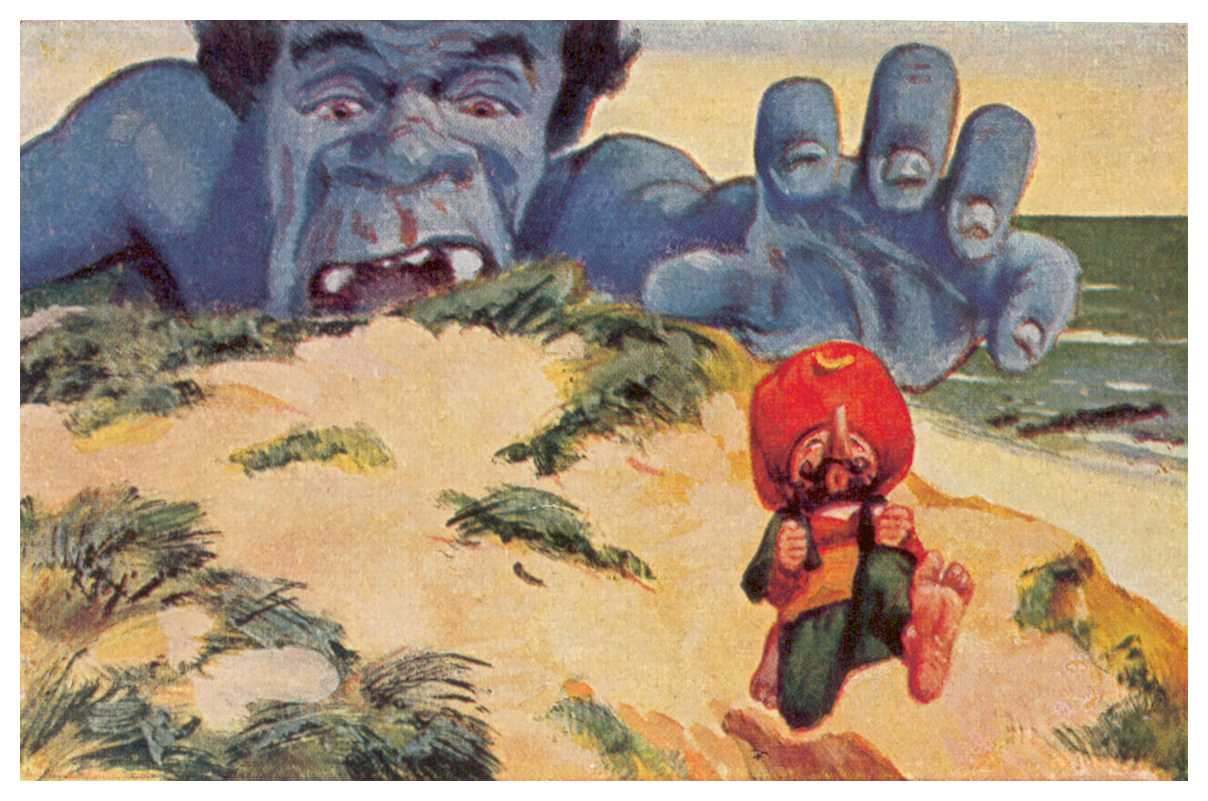
Illustration by Stefan Mart
(Image from Stefan Mart Website)
Above, you see yet another illustration by the mysterious 'Stefan Mart', this time from voyage four of the Sindbad series, a tale in which Sindbad is shipwrecked on a island and encounters enormous, blue man-eaters like the one depicted in the image reaching out toward the unfortunate Sindbad and us and reminding me for all the world of the terrifying purple people-eaters that my older cousin Velna used to frighten me with.
Be that as it may, I have noticed another, minor 'mystery', more of a question, actually, that occurred to me as I read the opening of this shipwreck story:
Wisset, ihr edlen Herren, daß meine vierte Reise einzigartig ist und ohnegleichen. Wieder war ich auf dem Meere. Meine ruchlose Seele mußte mit dem Seeteufel ein Bündnis geschlossen haben; er hatte mich wieder hinausgezogen, um mit mir in seinen unberechenbaren Launen weiterhin Schindluder zu treiben. In guter Fahrt ging es eine Reihe von Tagen, bis ein gewaltiger Sturm über uns hereinbrach, der unser Schiff zerschlug und die Trümmer wie ein Klafter Kleinholz auf eine Insel warf. Die meisten der Kaufleute waren mit ihrem Hab und Gut im Meer versunken. Ich selbst schwamm fast einen ganzen Tag im Wasser, bis Gott, der Erhabene, mir mit drei anderen Leidensgefährten Gelegenheit gab, festes Land zu erreichen.If you followed the links, then you noticed that I didn't translate the German myself this time -- unlike other posts on various topics where I did have to do the translation -- which explains why the English rendering above is so much smoother.
Noble gentlemen, my fourth voyage was unique and without parallel. I went to sea once again. My wretched soul must have entered into a pact with the sea devil, as he managed to lure me out again in order to torment me with his unpredictable whims and to subject me to further suffering. For a number of days all went well, but then a terrible storm broke over us, smashed our ship and threw what remained of it like a bundle of firewood on to the shore of an island. Most of the merchants had disappeared into the deep with all their worldly goods. I myself had been struggling in the water for almost a whole day before the good God had mercy on me and allowed me and three of my companions to reach land.
But that wasn't the 'mystery'.
Instead, I noticed a similarity to the story of another shipwreck:
That evil Influence which carryed me first away from my Father’s House, that hurried me into the wild and indigested Notion of raising my Fortune; and that imprest those Conceits so forcibly upon me, as to make me deaf to all good Advice, and to the Entreaties and even Command of my Father: I say the same Influence, whatever it was, presented the most unfortunate of all Enterprises to my View; and I went on board a Vessel bound to the Coast of Africa; or, as our Sailors vulgarly call it, a Voyage to Guinea.Eventually, this "evil Influence" driving the writer to sea leads him to shipwreck, somewhat as the "sea devil" (Seeteufel) led Sindbad to his shipwreck, whereby both encounter 'man-eaters'. This latter passage, of course, comes from Daniel Defoe's Robinson Crusoe.
Hence the little 'mystery' and my inchoate question: Is there some sort of influence, one way or the other?
I don't know if there's any influence of the Crusoe story upon Stefan Mart's re-telling of the Sindbad story, or if Defoe was influenced by the original Sindbad tale, but as one might expect, some scholars apparently think that Defoe received influence from the Sindbad series, or so says Martin Nick in "The Thousand and One Nights: Arab Contribution to World Culture," Issue 47 (July-August 2002) of Al Shindagah:
Sindbad the Sailor is the other celebrity in The Thousand and One Nights. He tells of his voyages in seven different stories where he either survives a shipwreck or is abandoned by his crew after having had put out to sea with merchandise. He manages to come out of the desperate situations either by wit or good fortune, or both, and returns home with loads of riches.Martin, however, does not cite these scholars, and I have no time today for following this wild hare down some rabbit hole.
Sindbad's stories are made exceptional in part by the references to fantasy creatures on several occasions. In his third trip, for example, Sindbad's ship is sunk by an enormous roc -- a monstrous bird which released massive rocks onto the vessel. In his fifth voyage, hairy apes attack the ship and abandon Sindbad and the crew on an island. Furthermore, the voyages are an interesting source of information on maritime business for that period, probably the early Abbasid era from around 750 to 850 BC. In spite of the fact that Sindbad's experiences were exaggerations of real-life dealings of traders, they are indeed well telling of different aspects of historical eastern life. As a case in point, in his stories Sindbad tells of the riches he takes home, namely precious metals, precious stones, sandalwood, and ivory to mention but a few. The overall imagery in Sindbad's miraculous experiences has, according to some scholars, played an important part for the formation of later world classics such as Robinson Crusoe and Gulliver's Travels.
See you tomorrow.
Labels: Robinson Crusoe, Sindbad, Stefan Mart
posted by Horace Jeffery Hodges @ 4:44 AM
4 comments