". . . is the
apostrophe."
And that makes me wonder ... what's an apostrophe? I'd write a long blog entry detailing its usage, but academia's a
small world, and it's already been zapped. More is zapped on the apostrophe than I'd've imagined. If I were
changing places with Christina Cavella and Robin A. Kernodle, I'd've lodged for myself a niche in the world of punctuation.
Which makes 8 apostrophes so far . . . though I could've used 9. The apostrophe, however, is all about leaving things out:
In 1559, the apostrophe appeared in England in William Cunningham's The Cosmographical Glasse (Parkes, 1993, p. 55). Sixteenth century English printers developed the mark to indicate omissions, but this convention is not as simple as it might sound. Initially, the apostrophe was intended to demonstrate the elision of a vowel, meaning the vowel sound had been omitted, assimilated, or slurred in pronunciation, as in th' inevitable end, but the apostrophe was also used to indicate a missing letter when the vowel no longer existed in the spoken form, as in can't (Parkes, 1993, p.55). Not surprisingly, there was much confusion concerning its usage until the middle of the 19th century, when printers and grammarians attempted to devise rules to govern the usage of apostrophes (Crystal, 1995, p. 203). Despite their efforts, however, much confusion remains today.
The use of the apostrophe to denote possession has its origins in Old English, which frequently attached the genitive singular ending –es to nouns. Hook (1999), points out that 60% of all nouns in Old English formed their genitive cases in this manner (p. 44); it is therefore not surprising that the current genitive ending –s has survived in Modern English. The apostrophe could be viewed as a way in which to mark the deleted vowel –e of the –es possessive ending, "derived from the Old English strong masculine genitive singular inflection" (Blockley, 2001, p. 35). Adrian Room (1989, p. 21) provides support for this view, citing the Old English word for stone, stän, whose genitive form was stänes.
Hook (1999) maintains, however, that the apostrophe is "a mere printer's gimmick, doubtless born of the mistaken notion that the genitive ending was a contraction of his" (p. 44). An invention of mortals, the apostrophe has indeed been subject to human error. The –es genitive ending,
often spelled and pronounced –ies or –ys in early Middle English, was confused as early as the thirteenth century with his, the possessive of he, so that Shakespeare could later write 'the count his gally', and even expressions like 'my sister her watch' appeared (qtd. in Hook, 1999, pp. 44-45).
The unstressed pronunciation of the genitive –es seemed to have caused many speakers to believe they were saying his. This usage presumably caused pronunciation problems and gender confusion with a noun such as woman or girl, or a plural noun like winners, but nevertheless was quite common (Hook, 1975, p.160). The apostrophe became a sort of "compromise" to indicate either the missing –e in the genitive ending –es, or the hi of the mistaken possessive indicator his (Hook, 1999, p. 45).
So, the scholars still aren't sure on this one -- or weren't sure circa 2004, when Cavella and Kernodle -- two M.A. students in the
TESOL program at
American University, Washington, D.C. -- wrote "How the Past Affects the Future: The Story of the Apostrophe" (
pdf),
AU TESOL Working Papers 2.
For their information, of course, they relied upon other scholars: e.g., M. B. Parkes,
Pause and Effect: An Introduction to the History of Punctuation in the West (Berkeley: University of California Press, 1993); David Crystal,
The Cambridge Encyclopedia of the English Language (Cambridge: Cambridge University Press, 1995); Donald Hook, "The Apostrophe: Use and Misuse,"
English Today: The International Review of the English Language, 15 (3), 1999, 42-29; Mary Blockley, "Its Time for a Sound Change,"
English Today: The International Review of the English Language, 17 (4), 2001, 35-37; and Adrian Room, "Axing the Apostrophe,"
English Today: The International Review ofthe English Language, 5 (3), 1989, 21-23.
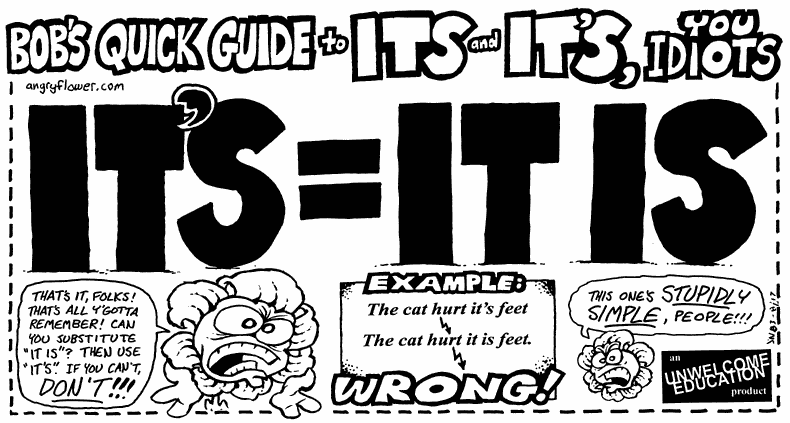
I know that this is boring for most people, but my interest was piqued by an Angry Flower cartoon about "
Its and It's, You Idiots," which the
Big Ho linked to, prompting
Addofio to
wonder how the apostrophe came to be used with "it's" but excluded from "its." Well, the answer is that the pronoun-verb contraction "it's" lacks an "i," whereas the genitive pronoun "its" lacks nothing, and as we now know, the apostrophe is all about elision, about leaving things out, and therefore...
But let us now, O Attentive Reader, turn away from the
apostrophe...
Labels: Punctuation