Tuesday, March 05, 2013

David Brooks on Learning Styles: Western vs. East Asian

David Brooks

David Brooks has an interesting NYT article published, "The Learning Virtues" (February 28, 2013), on the different attitudes toward learning between Western students and East Asian students, based on the research of Professor Jin Li:
Jin Li grew up in China during the Cultural Revolution . . . . [but] wound up marrying an American, moved to the States and became a teacher . . . . She has spent her career, first at Harvard and now at Brown, trying to understand how Asians and Westerners think about learning.

The simplest way to summarize her findings is that Westerners tend to define learning cognitively while Asians tend to define it morally. Westerners tend to see learning as something people do in order to understand and master the external world. Asians tend to see learning as an arduous process they undertake in order to cultivate virtues inside the self.
Consequently, Westerners and Asians talk in different terms about learning, as in this comparison of Americans and Chinese:
When Li asked Americans to randomly talk about learning they used words like: thinking, school, brain, discovery, understand and information. Chinese, on the other hand, tended to use phrases common in their culture: learn assiduously, study as if thirsting or hungering, be diligent in one's learning.
Conceptions of the student also differ:
In the Western understanding, students come to school with levels of innate intelligence and curiosity. Teachers try to further arouse that curiosity in specific subjects. There's a lot of active learning -- going on field trips, building things. There's great emphasis on questioning authority, critical inquiry and sharing ideas in classroom discussion.

In the Chinese understanding, there's less emphasis on innate curiosity or even on specific subject matter. Instead, the learning process itself is the crucial thing. The idea is to perfect the learning virtues in order to become, ultimately, a sage, which is equally a moral and intellectual state. These virtues include: sincerity (an authentic commitment to the task) as well as diligence, perseverance, concentration and respect for teachers.
These differences are said to have practical consequences:
Li argues that Westerners emphasize the Aha moment of sudden insight, while Chinese are more likely to emphasize the arduous accumulation of understanding. American high school students tease nerds, while there is no such concept in the Chinese vocabulary. Western schools want students to be proud of their achievements, while the Chinese emphasize that humility enables self-examination. Western students often work harder after you praise them, while Asian students sometimes work harder after you criticize them.
These are intriguing observations, but I wonder how well these really correspond to reality. Plagiarism is so widespread in Korean universities that I have to question the effectiveness of a moral conception of learning. Moral failings are easy to fall into, for one can be successful anyway, sometimes more so, but with conceptual failings comes failure in one's career. Cognitive failure corrects itself; moral failure requires an external critic.

Incidentally, I had my daughter read the article, and her response was to agree that there is a difference in the way that Koreans and Americans talk about learning, that the former do speak about the process in moral terms, but that Korean students don't actually take the moral talk seriously, so it has no practical significance on how they study, and that the one big aim is to score high on the nationwide university entrance exam.

I would add that while the cognitive approach might not be talked about in moral terms, an ethic is implicit, but this is an issue that itself deserves a blog post . . .

Labels: , , , ,

Tuesday, August 03, 2010

Is the 21st Century an "Asian Century"?


I received word today that an article by my friend Myongsob Kim and me, "Is the 21st Century an 'Asian Century'? Raising More Reservations than Hopes," has just appeared in the August 2010 issue of Pacific Focus: Inha Journal of International Studies, Volume 25, Issue 2 (pages 161-180). Here's the abstract:
Many are today arguing that the 21st century will be "the Asian Century," and much ink has been spilled over the splendid achievements of Asia as evidence of such arguments. However, this paper suggests some reservations regarding that argument, though also some distant hopes. First of all, we do not know yet what Asia really is, as there are too many geographical Asias. More effort should be made to conceptualize the geographical, or geopolitical, boundaries of Asia, which are both too blurred and too intertwined among sub-identities within Asia, and without. Second, Asia still has a lot of matters that need to be resolved by Asians themselves before the optimistic and audacious expression "Asian Century" can be legitimately used. In resolving those matters by themselves through international cooperation, the conceptual boundary of Asia could become clearer and a shared Asian geopolitical identity would have more possibility of emerging.
The article itself is not especially analytical, nor does it say anything particularly surprising. We devote several paragraphs to the Ancient and Medieval concepts of Asia. The latter of the two eras actually privileged Asia as the source of Christian truth. We thus express in passing a degree of skepticism toward Edward Said's famous orientalism thesis. We go on from there and attempt to define the boundaries of Asia, which was somehow pleasing to work through if perhaps less compelling to read, though necessary to do if one intends to talk about "Asia." We then get down to business, looking at Asia's strengths and weaknesses, none of which are surprising but all of which need pointing out, I suppose.

For those readers interested in an overview on the putative "Asian Century," this article might serve that purpose, for it has the virtues of clarity and comprehensiveness, though it cannot go into great depth or significant detail.

Labels: ,

Saturday, May 15, 2010

"Toward a Culture of Discussion," The Philosophy & Poetry Journal (Summer 2010)

East Asia
Spreading a Culture of Discussion
(Image from Wikipedia)

I learned this week about the publication of my article on the necessity for a culture of discussion in Asian societies (or anywhere, for that matter). It can be read online at the journal itself in my wife's Korean translation or here on Gypsy Scholar in my original English. For anyone interested, here's the journal information, with the link:
Horace Jeffery Hodges (호라스 제프리 하지스), "Toward a Culture of Discussion" ("토론 문화를 위해서"), The Philosophy & Poetry Journal (애지), Vol. 42 (Summer 2010), 25-38.
And here's the first paragraph of the Korean version:
1997년 싱가포르에서 '사고Thinking'를 주제로 한 제7차 국제회의가 열렸다. 여기에서 싱가포르의 철학자이자 외교관인 키쇼어 마흐부바니Kishore Mahbubani는 "아시아인들도 다른 사람들처럼 사고를 잘 할 수 있는가?"라는 상당히 도발적인 질문을 던졌다. 일 년 후에 그는 미국의 '내셔널 인터레스트National Interest'잡지에 "아시아인에게 사고는 가능한가?"라는 더욱 도발적이고, 거의 '모욕적인' 제목의 글을 기고했다. 이 글은 같은 해에 그가 동일한 제목으로 발간한 책의 일부를 차지하게 된다. 하지만 이 글은 저자가 의도했던 만큼 큰 반향을 불러일으키지 않았다. 3년 후에 2판을 찍어내면서 그는 이렇게 썼다: "무엇보다 실망스러웠던 것은 이 글이 발표된 후, 왜 아시아 사회와 문명이 유럽 문명보다 몇 세기 뒤쳐져 있는가 하는 질문이 아시아인들 사이에서 토론의 쟁점이 되지 못했다는 사실입니다."
The Korean translation of my entire article is a bit edited and thereby somewhat abbreviated, but here is the full, slightly longer English original:
Toward a Culture of Discussion

Horace Jeffery Hodges

Ewha Womans University

Introduction

In June 1997 at the 7th International Conference on Thinking, held in Singapore, the Singaporean philosopher and diplomat Kishore Mahbubani asked a singularly discomfiting question: "Can Asians think as well as others?" A year later in the National Interest, he followed up on this question by publishing an essay with the even more provocative, potentially insulting title, "Can Asians Think?" This essay became part of a book by the identical title that same year, but it failed to have the effect that Mahbubani intended, for as he writes three years later in the second edition, "My main disappointment with this essay is that it has not yet triggered a discussion among Asians on how and why their societies and civilizations fell several centuries behind European civilizations."

Mahbubani might not have triggered the discussion that he desired on the question of why Europeans rather than Asians experienced the Renaissance, Scientific Revolution, Enlightenment, and Industrial Revolution, but the topic of critical thinking among Asians was being broached by some Asian thinkers. For instance, the Thai philosopher Soraj Hongladarom presented a paper in 1998 on "Asian Philosophy and Critical Thinking: Divergence or Convergence?" that addressed Asia's lag behind Europe and noted several characteristics of Asian cultures that "prevent the full realization of critical thinking skills." Prominent among these are "the beliefs that teachers are superior and [thus] always right" and "that social harmony is to be preferred rather than asking probing questions." In short, discursive hierarchy and social harmony trump genuine discussion and critical thinking. Far from being dismissive about these things, Hongladarom holds that Asian societies perhaps once had valid reasons for deciding that "social harmony should take precedence over critical argumentation and open debates." In today's competitive, globalized world, however, he argues that Asian societies need real discussion and critical thinking.

Perhaps these interconnected issues deserve some discussion, and this discourse will necessarily be discursive, winding its way through such interrelated concepts as discussion itself, communicative action, discursive community, critical discourse, mockery, insults, free expression, critical thinking, self-irony, and various other correlatives of a culture of discussion.

What is Discussion?

But what is real, genuine discussion? In "Visions for Cities: Public Truth and Public Spaces," the Belgian philosopher Bart Verschaffel offers this rather stark answer, arguing that "discussion is a war game fought with questions and arguments to find out if somebody is right or not" based on "evidence or clarification and argument." But his metaphor of "war" is dubious because war is a zero-sum activity in which one side gains at the expense of the other, the object being to defeat the other side. That might better fit as metaphor describing the practice of competitive debate, where each side aims to win by vanquishing the other side, for those two sides are bellicose opponents, enemies. Discussion need not be debate in this sense of pitting mutual antagonists against one another. Since the aim is to attain truth, rather than to destroy an enemy, discussion can be a mutually beneficial 'game.' The metaphor of "game" also appears inadequate for the dialogue that takes place during discussion because "game" implies an artificial situation set off from the more serious business of life. As such, players follow the rules during play but eventually finish the game and walk away from it . . . until the next time to play. But discussion of the sort under consideration here proceeds according to rules that apply to all of life. One ought to have reasons and evidence for one's positions. The 'game' never really ends.

Perhaps the views of Jürgen Habermas on communicative action in his Theory of Communicative Action better express the role of discussion as a social activity that, ideally, pervades an entire culture because rationality in the form of argumentation is a capacity intrinsic to language. Granted, discursive argument is not the only sort of discourse, nor is culture defined solely by discourse, but Verschaffel seems to think of discussion as a more narrowly circumscribed activity of the sort that takes place in seminars. Yet even Verschaffel recognizes that discussion is a "dangerous game" because it, again ideally, poses questions about everything and gives every discussant an equal role. In principle, nothing is sacrosanct, and nobody is the final authority. It therefore transforms individuals and even society, and is thus potentially a destabilizing activity. One can readily understand why some societies have traditionally chosen to favor social harmony over rigorous discussion, as Hongladarom notes.

How Broad the Discursive Community?

Modern societies have decided that discussion is necessary, albeit threatening, but how free should expression be? Should free speech be accorded only statements that follow rigorous rules concerning reason and evidence? An interesting case arises with another theorist writing on a culture of discussion, the sociologist Alvin Gouldner, who described this sort of discourse in The Future of Intellectuals and the Rise of the New Class. He referred to it in rather formal terms as the "culture of critical discourse" and held it to be specific to a new class of intellectuals. This discourse is characterized as "relatively more situation-free," meaning that it "forbids reliance upon the speaker's person, authority, or status in society to justify his claims." The ideal of such discourse is "one word, one meaning" for everyone always.

Gouldner saw this culture of critical discourse as the 'language' of a new intellectual class encompassing the sciences as well as the humanities. One wonders if critical discourse's rigorous ideal of "one word, one meaning" might not make discussion rather stilted if strictly applied to every term uttered in a discursive argument, but Gouldner was largely restricting his culture of critical discourse to the narrowly designated, new intellectual class that he had identified. In a genuine culture of discourse, however, the communicative group would need to be broadened to include, potentially, everybody in a society. But to do so would require loosening Gouldner's criteria a bit and noting the critical discursive actions that intellectuals share with other members of any society characterized by a culture of discussion. Fundamentally, this means the right of everyone to pose questions about anything with the expectation that answers should offer reasons and evidence.

Dealing with Mockery?

One intriguing question that arises, and not merely incidentally, is how one should respond to insulting mockery. The mocker perhaps does not accept the rules for a culture of discussion in a strict sense and offers not reasons and evidence but satirical insults. What ought one do if mocked? Should one follow the example of Gouldner himself? According to the noted essayist Scott McLemee in "Wide-Stance Sociology," Gouldner developed an antagonistic relationship with a doctoral student at Washington University named Laud Humphreys. When a satirical poster appeared in the sociology department depicting Gouldner as a bird of prey that feeds on personalities rather than on ideas, Gouldner suspected Humphreys as its author. The irate scholar sought out Humphreys in his graduate student office, struck him down with a blow to the face, and kicked him as he lay on the floor.

Confronted by insulting mockery, Gouldner seems to have believed that honor stained called for physical violence. In an earlier age, perhaps he would have challenged Humphreys to a duel. Did Gouldner betray his own principles, the rules of his very own culture of critical discourse? Whether or not Gouldner broke with his own theoretical system in attacking Humphreys, insults should in fact be protected speech in a culture of discourse because feeling 'insulted' is a purely subjective reaction. For example, some might feel insulted by the application of critical principles to the study of religion, but that cannot justify any right to physically attack the one applying such principles. Moreover, even calculated insults play a role in literature and the arts and ought to be protected speech.

A Miltonic Excursus

Turn therefore to one of the greatest of literary artists, John Milton. In his famous defense of what we would today call free expression, Milton utters a plea in Areopagitica for what he considers the most basic freedom: "Give me the liberty to know, to utter, and to argue freely according to conscience, above all liberties." Why allow him that? Because he believes that through untrammeled utterance, truth will win, as he reminds his readers concerning truth only a few lines later in his text: "Let her and Falsehood grapple; who ever knew Truth put to the worse, in a free and open encounter." What should interest contemporary readers is that Milton apparently meant for this "free and open encounter" in the interest of truth to include polemics and even personal attacks.

One sees this sort of polemical, personal attack in Milton's insults of Anglican bishops in Book 1 of his Reason of Church-Government Urged against Prelaty, for he bluntly accuses them of habitually resorting to malicious slander and sophistry when their weak arguments fail them. Whether Milton be right or wrong in the substance of his accusations, he is being decidedly polemical in leveling personal attacks and even insults. He accuses others of slander. He might well be accused of it himself. Certainly, his opponents could well feel themselves insulted. Consider the polemical tone in his attack upon Anglican bishops with words that slur the Irish and the Catholics. He calls the Irish "murderous," designates them as "the enemies of God and mankind," and refers to them as the "cursed off-spring" of the Anglican bishops' "own connivance." The Anglican hierarchy, claims Milton, "maintains and fosters all papists and idolaters as tolerable Christians," a toleration that Milton deplores. Milton blames the bishops for an indifference to the souls of those under the sway of English rule, an indifference that left the Irish in their Catholic faith, but Milton also clearly has disdain for the Irish themselves, as well as for Catholics generally and (of course) for 'idolaters.' Obviously, Milton is hardly above slander, insults, and polemics generally, and he therefore must have felt himself free and justified to speak in insulting terms.

The Right to Insult?

Should such ad hominem attacks be permitted? As already maintained above, yes. Strictly speaking, personal attacks stand mostly outside a culture of discussion, for they are usually poor arguments for or against a substantive position. But they should be protected speech because the defensive wall constructed to guard free discussion needs to be at least as encompassing as the wall built around the Torah in Rabbinical Judaism. Absent that wall of protection, even a substantive statement could be taken as an insult, so if insults are not protected speech, substantive arguments could be forbidden. In a hierarchical society, for example, the substantive words of an individual lower in the hierarchy could be taken as insulting if such words merely question the views of someone higher in the social structure.

In Korea, Japan, and China, for example, with their strongly hierarchical social structure, precisely this sort of problem arises, such that the substantive disagreement of a 'junior' with a 'senior' can be taken as an insult by the latter. Critical arguments are thereby suppressed, and truth (as Milton would say) often suffers. This has been trenchantly discussed by the scholars Ho-Chul Lee and Mary Patricia McNulty in their article "Korea's Information and Communication Technology Boom, and Cultural Transition After the Crisis." In this article, they note that Confucian hierarchy stifles free expression because debating or criticizing individuals of higher rank is considered impolite. Korean culture therefore teaches people not to raise probing questions or to offer critical opinions, but to express themselves ambiguously rather than with a clear yes or no. This hinders Koreans from developing the culture of discussion fundamental to democracy and also to modern business. They attempt to save face, both their own and that of their interlocutor, thereby stifling free discussion and debate. Confucian values put priority on social etiquette over substance. The younger are supposed to respect and obey the older, just as the lower-ranked must respect and obey the higher-ranked, and this deference acts as a barrier to free expression.

From the research by Lee and McNulty, one sees just how subjective the sense of 'feeling insulted' can be. In East Asian societies shaped by Confucian values of hierarchy, any open expression of a contrary opinion can be taken as an insult by a higher-ranking individual, and the awareness of this by lower-ranking individuals can too often suppress uncomfortable truths. Without the right to insult, a free and critical culture of discussion can therefore not be achieved, and since the latter is necessary to the pursuit of truth, then 'insults' must be accepted as legitimate, legally protected expressions.

Core Critical Thinking

Insults might need to be protected speech, but at the core of a culture of discussion lies the ideal of critical thinking. What, however, is "critical thinking"? The consensus of approximately 200 experts has been summarized in "Critical Thinking: What It Is and Why It Counts," an article written by the philosopher and educational theorist Peter Facione, who notes the importance not only of skills but also of dispositions.

These experts say that in terms of skills, the ideal critical thinker consciously engages in self-regulated judgments about opinions held and actions needed. This requires several subsidiary skills, among these being the closely interrelated skills of interpretation, analysis, evaluation, and inference. Interpretation involves comprehending and expressing the meaning of what is being judged. Analysis involves identifying the logical relations among expressions stated. Evaluation involves assessing the credibility of statements made and the logical strength of the relations among these. Inference involves drawing reasonable conclusions and conjectures based on statements and evidence. Another subsidiary skill is explanation, which involves presentation of cogently stated reasons and clarification of the bases upon which a judgment is formed. Clearly, there is a lot 'involved' for rigorous critical thought.

But skills, as already noted, are not sufficient. The experts cited by Facione also identify various dispositions characteristic of the ideal critical thinker. According to them, a critical thinker should as a matter of course be curious, informed, rational, open-minded, flexible, fair, honest, prudent, reflective, clear, organized, searching, reasonable, focused, and persistent. Such a list of dispositions, and also of skills, is open-ended, for one could likely think of others to add, but the list as it stands summarizes the dispositions suggested by the experts and can serve, along with the skills, as a convenient statement of a complex ideal.

Because critical thinking is a powerful resource in personal and civic life, one aim of education in a culture of discussion should be to develop critical thinking skills and nurture the dispositions that can provide valuable insights and serve as the discursive core of a rational, democratic society. Producing critical thinkers would not be an educational system's sole aim, of course, for good thinking involves other things, such as ethical reasoning and creative imagination, but critical thinking is also relevant for these other aspects of thought as a pervasive, self-regulating phenomenon. Education alone cannot reform the discursive culture of an entire society, and perhaps relatively few individuals will develop the skills and dispositions to develop as outstanding critical thinkers, but an ideal of critical thinking can serve as an aim, and particular individuals can come to serve as its potential exemplars.

Conclusion

Facione's skills and dispositions, like Gouldner's culture of critical discourse, are rather technical elaborations of the reasoning intrinsic to a culture of discussion. What their explications generally have in common with those of Verschaffel and with Habermas is an emphasis upon reasons and evidence rather than upon the social position of the speaker. If a society wishes to develop a culture of discussion, then discursive hierarchy will require flattening and social harmony will need to be a possible consequence of discussion rather than a normative condition imposed at the outset. Hongladarom remarks that "Cultures, like humans, often make decisions which later are amended or revoked, with new decisions made, when things are not the same any longer. Decisions to prioritize one set of values over another are not etched in stone." But transforming an entire culture takes time. For example, the decision to construct a Confucian Korea may have been reached early in the Joseon Era, but the actual process took several hundred years and never fully succeeded against the more deeply entrenched Buddhism. A 'decision' to inculcate a culture of discussion will likely have faster results in the contemporary world, given the globalizing pressures that push individuals in this direction and the material rewards that are promised to follow, but the process, even so, will not be easy. Not only will one need skills in critical thinking, one will need the right disposition, and since a culture of discussion implies a right to insult, then that disposition will necessarily include a sense of self-irony. If such skills and dispositions are developed, Mahbubani might yet experience the wide-ranging discussion that he desires.

References

Facione, Peter A. "Critical Thinking: What It Is and Why It Counts." Insight Assessment.
Gouldner, Alvin W. The Future of Intellectuals and the Rise of the New Class. New York: Seabury, 1979.
Habermas, Jürgen. The Theory of Communicative Action. Translated by Thomas McCarthy, Cambridge: Polity, 1984-1987.
Hongladarom, Soraj. "Asian Philosophy and Critical Thinking: Divergence or Convergence?" Third APPEND Seminar on Philosophy Education for the Next Millennium, May 6-8, 1998, Chulalongkorn University.
Hughes, Merritt Y., editor. John Milton: Complete Poems and Major Prose. Hackett Publishing Co., 2003.
Lee, Ho-Chul and Mary Patricia McNulty. "Korea's Information and Communication Technology Boom, and Cultural Transition After the Crisis." Economic and Social Research Institute (ESRI), April 18, 2004 .
Mahbubani, Kishore. Can Asians Think? Singapore: Marshall Cavendish, 2004.
McLemee, Scott. "Wide-Stance Sociology." Inside Higher Ed, September 12, 2007.
Verschaffel, Bart. "Visions for Cities: Public Truth and Public Spaces." Productivity of Culture, ECCM Symposium, October 17-21, 2007.
Well, there it is, my latest effort at 'thinking' things through to the end. At least it got published, so perhaps somebody will read it . . .

Labels: , , , , , ,

Monday, October 19, 2009

José Ortega y Gasset: "Europa es el único continente que tiene un contenido."

José Ortega y Gasset
(Image from Wikipedia)

In his book Eccentric Culture, a fascinating analysis of European cultural identity, the French philosopher Rémi Brague relates an anecdote about Ortega y Gasset. The latter had recently returned from America and was asked the reason for his return. He answered with a pun of ambiguity:
"Europa es el único continente que tiene un contenido."
The Spanish word "continente" means both "continent" and "container," permitting either of two translations for Ortega's reply: "Europe is the only continent that has a content" and "Europe is the only container that has a content." He meant both, and one sees what he meant. Europe has a cultural unity that other continents lack.

Perhaps Europe's cultural unity is less impressive as a unique fact when one reflects that this continent is the artifact of an arbitrary line drawn to separate what is considered 'Europe' from what is considered 'Asia.' Looked down upon from above, Europe seems merely an Asian peninsula.

But the imaginary line exists in everyone's mind. To its west, Europe. To its east, Asia. West of the line, we find a civilization that integrated Athens and Jerusalem. East of the line, however, we find many civilizations. To be identified as "Asian" is therefore only a geographical distinction and implies nothing about one's cultural identity. Whereas a German might casually remark, "I am a European," and thereby make a recognizable statement of cultural identity, a Korean would not formulate a corresponding remark in stating, "I am an Asian."

For a Korean to offer a parallel statement of cultural identity, the formulation would have to be, "I am a Korean."

But what does that mean -- what is a Korean?

I've been 'officially' asked this question concerning Korean identity and now have to reflect upon it. Perhaps my recent encounter with Hwang Sok-yong's novel The Guest will provide some grist for this cultural mill, and I'll certainly be grinding away, but others with more knowledge than I are invited to comment here.

Labels: , , , ,

Sunday, November 09, 2008

Claire Berlinski's first real job . . .

(Image not from Claire Berlinski)

Long-time readers will recall the above image, which appeared some months ago when I was reading Berlinski's interesting though not scholarly book Menace in Europe in preparation for my Yonsei UIC course on multiculturalism and the future of Europe.

At the time that I posted the image, I made a mental note to mention a funny story that she tells about herself on her website, where she poses a question about herself for our benefit: "Have you ever had a real job?"

In reply, she begins as I might have:
Yes! I'd just finished my doctorate -- this was 1995 -- and . . . I was beginning to realize that the next step in my life, the expected step anyway, was to apply for tenure-track teaching jobs. Every time I thought about this I felt a keen sense of mounting desperation.
I also finished my doctorate in 1995 and therefore know from experience the desperation . . . but I married well and found myself living the high life in South Korea. Berlinski also went to East Asia -- not through marriage but through the offer of a not-entirely-respectable job:
I was paging desultorily through a copy of The Economist when I noticed a classified ad: An Asian publishing group was planning to launch a pan-Asian daily newspaper based in Bangkok, and was looking for "experienced sub-editors with an extensive knowledge of Asian languages and politics." I wasn't even sure what a sub-editor was, and would have been hard-pressed to locate any Asian country on a map -- I could have found China, maybe -- but on a whim I sent them my resume. They wrote back, inviting me to an interview in a hotel room in London. The curtains were drawn, the room reeked of smoke, and the two men interviewing me -- a Thai with terrible skin and a German whose entire body was yellow with nicotine stains -- were clearly drunk. As luck would have it, they just happened to ask me the one question I could answer: What did I think of the Nick Leeson bond scandal? The night before I'd been at a dinner party hosted by a pair of mathematicians, and had heard an earful about Leeson. I promptly relieved myself of a detailed discourse on Stochastic calculus, Markov methods, and the characteristics of economic equilibria that support Black-Scholes option pricing -- having no idea whatsoever what any of these terms meant, of course. Fortunately, they asked no follow-up questions. Their only query was whether I smoked. "I don't," I said. "But if the job requires it, I'll learn." It seems this was the right answer.
Good answer. If I ever get asked that question at a tenure-review meeting in some alternate universe, I'll have to remember to give the same answer.

Nah, just kidding. The correct answer is: "I've published something on that."

But you're wondering about Berlinski's job:
Next thing you know, I was flying to Bangkok, installed in an orchid-filled apartment with a cohort of bowing servants, and working behind the scenes at a paper quite unlike any news organ I'd ever imagined -- a place where money was never an object; where the correspondents received salaries so profligate as to make the playboys of the Saudi royal family blush; where from time to time the publisher strode in accompanied by a dozen stunningly beautiful Chinese courtesans, made cryptic pronouncements about countering the White Man's neo-colonial journalism, and then took to his heels and strode out, leaving us all mystified; and where we never -- I mean never -- produced an article anyone would ever want to read. Everything we turned out was bilge: lists of unreadable economic statistics, bizarre theories about secret conspiracies between Mainland China and Taiwan; ranting incoherent editorials about the perfidy of the IMF. We were the only newspaper in the world that defended the SLORC. Yet there was so much money flowing through that place! And no one ever cut it off!
Berlinski doesn't say whether or not sub-editors received any of those profligate salaries, but she seems to have been satisfied despite her perplexity:
I simply couldn't figure it out, although I wasn't inclined to ask too many questions, because it was a really cushy job. I have many stories about that newspaper. Our features editor was thrown into a Thai dungeon on trumped-up drug charges, our deputy editor-in-chief was found to be moonlighting as a brothel-owner, our Burma correspondent fell into a sewer while literally chasing a story and nearly died of blood poisoning. But those are for another book.
Eventually, Berlinski uncovers the truth about her job . . . maybe:
Anyway, one day, a woman I'll call E., our correspondent in a country I'll call Klong-Klong, strode into the office for a quarterly meeting with the editor-in-chief, a man I'll call Vindaloo. I remember her well: She was an attractive, well-put-together woman in her mid-thirties with an air of breezy self-assurance. She wore very bright red lipstick. She invited me to get a massage with her, and over the course of the afternoon E. told me two very fascinating secrets -- first, that she had slept with Hugh Grant, who was "nothing to write home about," and second, that the newspaper I worked for was "obviously" a highly elite, ultra-secret economic intelligence gathering unit for the CIA.

The second she said that, it all fell into place . . . .

Was it true? I have no idea. I'll never knew the truth -- how could I? But the more I thought about it, the more I loved the idea. From that day, I began to look at everyone around me in a different light. And once you start looking at things that way, you never stop.

I've been intrigued by the CIA -- and the people who work there -- ever since.
Actually, I doubt that the CIA would have been throwing around so much money, and the pan-Asian paper that she worked for is said to have been the old hardcopy edition of the Asia Times, which doesn't strike me as a likely front for the CIA . . . though I cannot quite articulate why.

But her suspicions about the job led her to write a spy novel, Loose Lips, which begins in much the same way, as you can learn for yourself by reading the first chapter online at Amazon.com.

But as for the question that Berlinski poses about herself for our benefit -- "Have you ever had a real job?" -- I have to wonder if she has genuinely answered it if her suspicions were correct.

Is a job for a CIA front a real job?

Labels: , ,

Sunday, April 15, 2007

Gypsy Scholar's identity revealed!

Gypsy Scholar: The Ugly One
(Image from 매일경제)

Asia may be rising, but we all remained seated.

For those of you interested in who "we all" were, the scholars visible in the photo, from left to right, are Kisoo Kim (Discussant, Sejong Institute, Korea), Horace Jeffery Hodges (Presenter, Kyung Hee University, Korea), Myongsob Kim (Presenter, Yonsei University, Korea), Chong Wook Song (Chair, Seoul National University, Korea), Dong Zhiyong (Peking University, China), and Zhang Jian Ping (National Development and Reform Commission, China).

Partly visible, just behind my capped head, is the capless head of Richard P. Suttmeier (University of Oregon, USA). Invisible is Ha-Lyong Jung (Kyung Hee University, Korea).

The photo and accompanying article appear in the Korean paper 매일경제 (Maeil Kyung Jae / Maeil Business Newspaper). Here are the money quotes:
김명섭 연세대 교수와 함께 발표자로 나선 호레이스 제프리 호지스 경희대 교수는 "아시아를 `서방과 그 나머지(the West and the rest)`라는 도식으로 봐서는 세계화로 인한 문제를 푸는 데 도움이 되지 않는다"며 "아시아 스스로도 세계의 책임 있는 주체로 스스로 보편성을 찾아내고 서방이 지고 있는 무거운 짐도 분담해야 할 때가 됐다"고 운을 뗐다.

그는 단순히 넓은 형태로 협력을 추구하는 `스파게티 그릇`형 지역협력 차원에서 벗어나 이제는 `샐러드 그릇`형 국제협력에 나서야 한다고 강조했다.

Professor Kim Myongsob, of Yonsei University, and Professor Horace Jeffery Hodges, of Kyung Hee University, opened [the conference by] noting that "the sort of dichotomy [that is often conceptualized as one] between 'the West and the rest' is not helpful for solving the problems caused by globalization." Instead of being "the rest" after "the West," Asia should find its own universality not only for becoming a responsible subject of the world, but also for sharing the heavily-laden burden of the West.

They emphasized that [in Asian matters,] a salad-bowl-type process based on the nation-state should not be subordinated to a spaghetti-bowl-type process based on supranational networking.
I'm tempted to leave these quotes from our talk just as obscure as they appear to be, but I suppose that I ought to provide some clarifying remarks.

The "West and the rest" remark is an allusion to an observation made by Samuel P. Huntington (and also by Roger Scruton) that the 'rest' of the world is no longer satisfied with being second to the West. Our point was that if the non-West, specifically Asia, is rising, then it needs to assume the responsibility proper to great power and can't simply blame 'globalization' for the problems that it faces.

As for "salad bowl" versus "spaghetti bowl," these are metaphors -- borrowed from other scholars -- referring to a system of nation states versus a network of international organizations. Our point here was that international arrangements within Asia will have to come into being based upon the nation states, partly due to the passionate nationalism that we often find in Asia and partly by analogy to how the European Union developed through the decisions of nation states.

One might be tempted to look for more substance on which to subsist in these throw-away quotes, but don't attempt to mill too much flour from this grist.

Labels:

Wednesday, March 28, 2007

Europe at Fifty: Asia Inconceivable?

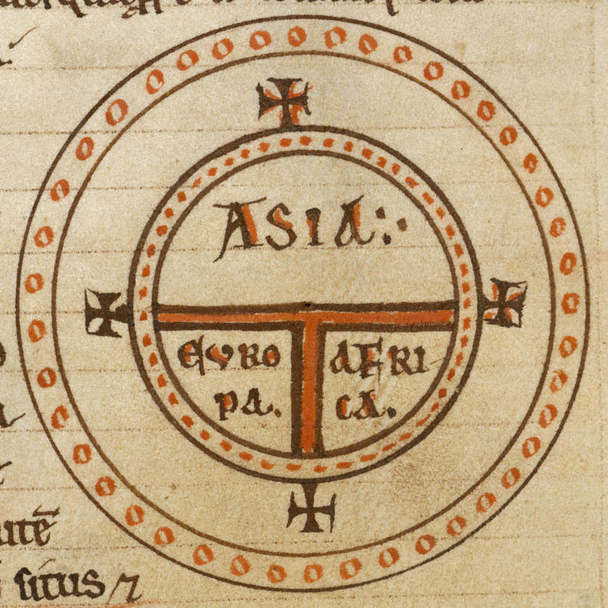
Seventh-Century-Inspired T/O Map of the World
Isidore of Seville (ca. 560-636), Etymologiae (12th-Century Copy)
(Image from Wikipedia)

Last Sunday, Europeans celebrated the fiftieth anniversary of the European Union (EU) -- if one assigns the EU's origins not to the European Coal and Steel Community (ECSC), formed in 1951 through the Treaty of Paris, but to the signing of the Treaty of Rome, which among other things established the European Economic Community (ECC) on March 25, 1957.

I happen to have come into the world about eight weeks later, so I've pretty much grown up with the new Europe and recall very clearly that American term for the EEC, the "Common Market," an expression that perhaps dates from 1968, when internal tariffs were abolished in the EEC (but I'm not sure).

My first understanding that something more than economics was going on came in 1981, when I was helping to cater an official event at Stanford University. Several Stanford graduate students and I were taking a break in the kitchen when a young, handsome fellow from the French consulate in San Francisco noticed the correspondingly young, lovely women with whom I was working and stepped inside to flirt with them. But he was charming and intelligent, which made up for his being also French, and he happened to make a remark that caught my attention as he was discussing the Common Market:
"We Europeans call it the European Community."
Officially, it was called the European Economic Community, so he must have meant that the Europeans called it the "European Community" as a convenience, for only with the Maastricht Treaty of 1992 did the term "Economic" get officially dropped.

But I recall thinking, "Oh, it's not just a market, it's a community." That word seemed to me to imply a political unity. I didn't know much about the EEC at that time, but I guess that my hunch was correct.

At any rate, it's certainly political these days, as a deluge of newspaper articles have recently affirmed, not only over the weekend but last week and this week as well.

One commenter, Roger Cohen, whose weekly articles I always enjoy, published a piece in the New York Times under the title "For Europe, a Moment to Ponder" (March 25, 2007), but which I read here in Korea in the International Herald Tribune under the title "A transformed Europe celebrates uncertainty: The EU, at 50, is still a work in progress" (March 24-25, 2007). In the IHT's European edition, the title was slightly different: "For a Europe remade, a celebration in uncertainty" (March 23, 2007).

Sometimes, I think that I try to be a little bit too precise.

Anyway, Cohen remarked upon European unification in a manner concise but connecting a lot of points:
What began in limited fashion in 1957 as a drive to remove tariff barriers and promote commercial exchange has ended by banishing war from Europe, enriching it beyond measure, and producing what [the Polish writer] Mr. [Adam] Michnik called "the first revolution that has been absolutely positive."

Asia, still beset by nationalisms and open World War II wounds, can only envy Europe's conjuring away agonizing history, a process that involved a voluntary dilution of national sovereignty unthinkable in the United States.
I like this sort of intelligent, informed, and broad-ranging but clear writing that comes from the pen of Mr. Cohen. Look at how many things he brings together in two brief paragraphs: free market economics, World Wars I and II, Poland's Solidarity Movement, the American, French, and Russian revolutions, Asian and European nationalism, and American exceptionalism.

Did I miss anything?

Note that Cohen mentions Asian "nationalisms." Not merely by coincidence, Stanford professor Shin Gi-wook, who currently acts as Director of Stanford's Shorenstein Asia-Pacific Research Center, wrote an article, "Conflicting memories hinder unity in N.E. Asia" (March 27, 2007), for The Korea Herald, which is currently publishing a series on nationalism in Northeast Asia.

Shin notes that Northeast Asia is developing economic and cultural links that are drawing the nations in this region closer together but that the nations of this region are pushing emotional nationalisms that are threatening to tear it apart:
Growing economic ties and a new interest in cultural exchanges are bringing the countries of Northeast Asia closer together. Yet wounds from past wrongs -- committed in times of colonialism, war, and dictatorship -- are not fully healed. All nations have some sense of victimization -- Japan vis-a-vis the United States and Russia, and China and Korea vis-a-vis Japan -- and often blame others, rather than taking responsibility.
Shin proposes some solutions, among these: 1) developing a common understanding of the past; 2) using the shared past to promote regional reconciliation; and 3) encouraging critical, independent thinking to young Asians about their pasts.

Easier said than done, but Shin also presents suggestions on how to accomplish these things -- the reading of which, I'll leave to those interested.

These issues are currently on my mind because I and my poli-sci friend at Yonsei University, Kim Myongsob, are frantically working on a paper for an upcoming political science conference sponsored jointly by Korean Political Science Association and the Academy of East Asian Studies, Sungkyunkwan University: The Rise of Asia and Its Future: Global Impacts, Regional Implications, and National Ramifications (April 13-14, 2007).

Our paper will be presented in the first session (9:40-12:00) on April 13th, and we've tentatively given it the title "When Asia Matters: What Asia, Why and How?"

I can't reveal much about the paper at this time, but suffice it to say that Myongsob is a broad thinker and has me stretching the limits of my knowledge on this project. It ain't easy defining what Asia is, for it's so many things that imagining an Asian identity seems nearly impossible without falling back upon Eurocentric images to help us. So . . . we actually do a bit of that back-falling. And despite Edward Said, such views were never uniformly 'orientalistic' -- as the above T/O Map of the world demonstrates, for by placing Asia with its Garden of Eden at the top, where Christ's head would be on the crucifix pictorially alluded to, such representations of Isidore of Seville's description of the world privileged Asia both cartographically and iconographically.

And that's not a small thing for Westerners to do.

Labels: ,